Thoughts Beyond the Novels: What’s in a Name?

At some point in this blog, the author
will get a little personal in her choices
of names due to their meanings
throughout the three novels, however
trite.

Once upon a time, there was a young woman named Sarah whose husband was named John. The winds of trade made them a union. For her, privileged in her own land, she met some discomfort with her new family because Sarah was a Jewess and John was Catholic in Nova Scotia in the early 1800’s. As noted below, one can perceive that Sarah knew Shakespeare, especially about the star-crossed couple, Romeo and Juliet. (By the way, Sarah in Hebrew means Hebrew name that means “princess,” “noblewoman,” or “lady” due to the biblical wife of Abraham.) The couple had a son they named Arthur in 1889. During the time of his birth, “Arthur” ranked 20th in popularity; and it bore the following meanings: “bear,” “Thor,” “eagle,” and “strong man.” The continuation of the family origin story is unknown. (Much is conjecture. Nonetheless, Grandfather Rose was a builder of wooden ships that sailed to far lands. Arthur Rose became an accountant for the Singer Sewing Machine Company, which became the Singer Corporation in the 1900s. Arthur was assigned to the Mexico hub.)

The author surmises that Sarah knew the story of Romeo and Juliet when she gave Arthur his middle name coupled with the surname—Montague Rose. This insight comes when we think of what Juliet said to Romeo about the meaning of a name.

Illustration

Mask On Book. Classical white Venetian mask on old book against dark background (Dreamstime.com)

In Act II, Scene II, Juliet implies that names are arbitrary and do not change the essence of Romeo whose family name is Montague, making him an enemy of her family. In their forbidden moments, Juliet thinks over Romeo’s surname: “What’s in a name that which we call a rose / By any other word would smell as sweet?” Her words imply that, though names carry immense meaning, heritage, prejudice, and/or power, her love was in true form. When Sarah took to heart what was spoken by Juliet, did Sarah identify her circumstances with any of the implications from the family into which she married? Her suffering was twofold, for her own family disowned her for marrying a Catholic. The exogamy practice, which prevails in certain cultures, was both ethnic and religious in nature.

So, from a pragmatic perspective, name labels matter a lot, for they reflect culture, heritage, and/or history. They can also, carry baggage and influence social and business perceptions. They can create stereotypes. But from a philosophical perspective, a name is simply a label or a social convention; and It should not affect the value of the named person.

Basically, the origin of a name can be from a trade, a location, or bestowed affection. An example of this is the name Armentano, which can indicate both a place, Armento, in Calabria and Basilicata, Italy, and a trade name (Armento) as cattle herder.

A name can contain identity and meaning—aspirations, hopes, or family history to guide a person’s identity, A legendary example of this is the birth of Siddhartha Gautama. According to Buddhist legend, Queen Maya had a dream, during which time a white elephant (explained below) entered her side, When she awoke, she realized she was pregnant. She knew of the prophecy beforehand in which case, if the child born were to remain home, the child would become a ruler; however, if the child were to leave home, the child would become a universal leader. Queen Maya decided to name her neonate Siddhartha, a Sanskrit name that means “one who has attained his goals.”

As for the symbolism of the “white elephant,” it represents the sacred nature of Maya’s pregnancy—in that a significant and powerful being would be born—foreshadowing the auspiciousness of her son’s birth would highlight wisdom to be brought to mankind through him, thus the Awakened One (Buddha).

Names and their meanings play an important part in the naming of various characters in the three novels: Book I introduces Dara who is named after my lovely dance teacher of Raqs Sharqu (Arabic name for “Eastern Dance”, Belly Dance in English). Her name was Maja (an alias) and was born in Egypt. Nona, which means “Nine” (or “ninth”) is also introduced in Book I. She was named after the first born of my college mentor (chief librarian). Nona foreshadows Ana in that the word “nona” is often used as a prefix in a number of scientific and other technical terms (e.g., nonapeptide).

In Book III, Ana, an MIT physicist, was named after a dear high school friend who felt betrayed because I married the son of the colonel who fired her father, a civilian personnel officer who sold honorable discharges for monetary gain). I do not think my friend knew why her father was discharged.

Ana is a name I would have given myself if my Father had not told me, when I was about five, that I should never let my name Armida be changed. In some ways, I betrayed him because, when in high school, I gave myself the nickname “Mimi” and then, during my federal career, “Armee,” pronounced “Army.” Then, there was this girl I knew who would call me “Army Navy” for “Armida Nagy.” What a drag! Father just did not know that my name was mispronounced and misspelled all too often. It is only now that I am long in the tooth that I embrace my given name. This was my secret from my dad.

In all three novels, there is one name that holds an honorary place. The name is “Andrew, or variations thereof. of my Father’s given name, meaning “manly,” “strong,” or “brave.” He was all three in every sense of the word. His characteristics are reflected in the characters in the trilogy. I was the apple of his eye, and he was my hero.

One thing is certain, however, about the women of the Armida Trilogy. They all showed a potential for leadership. Even the Dalai Lama contemplates on reincarnating as a woman since he believes women are particularly suited for leadership due to their inherent compassion. He surmises that, if there were more female leaders, the would would be more peaceful. In most instances, in their compassion, they also know how to give and to instruct, instead of take, take, take.


What’s in a name? Everything and nothing at all. I will settle for “I am that I am” . . . a vibrant part of the universal eye of consciousness, being. Or as Popeye said in the 1933 animated film, “I yam what I yam.”

Illustration

Mind’s Eye: AI Abstract Poartrait of Human Consciousness and Energy Flow (Dreamstime.com)

The Armida Trilogy, which is not named after the author’s given name per se, is named after a fictitious character, Armida, with historical and literary connections: A Damascus warrior-queen from the 1st Crusade in Torquato Tasso’s Gerusalemme Liberata (1591). Tasso’s epic poem had inspired numerous artists and composers, each interpreting Armida’s character in unique ways. As such, she embodies the archetype of the forsaken woman in literature. Yet, many view Armida as a more relatable and sympathetic figure, adding depth to her portrayal. For more information about the various artists and composers who were inspired by Tasso’s Gerusalemme Liberata,

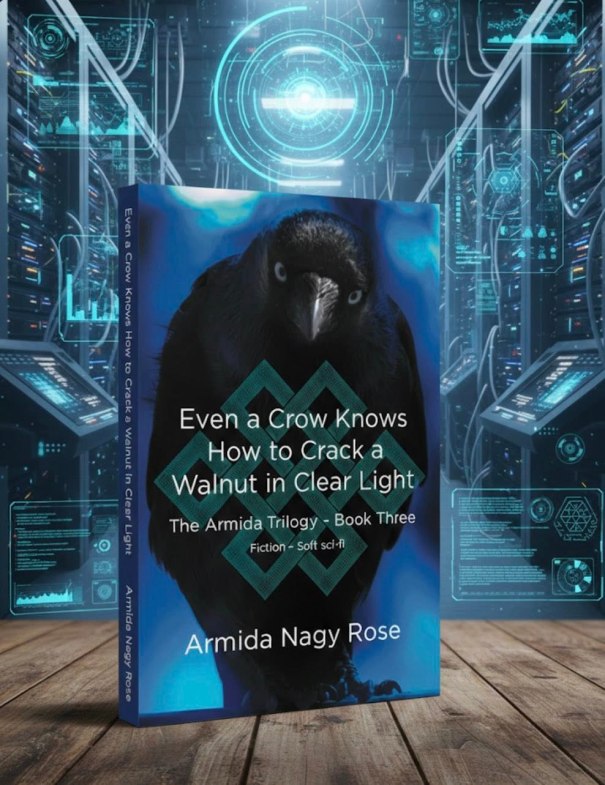
PRESS RELEASE by Publisher on BOOK THREE–EVEN A CROW KNOWS….

Headline

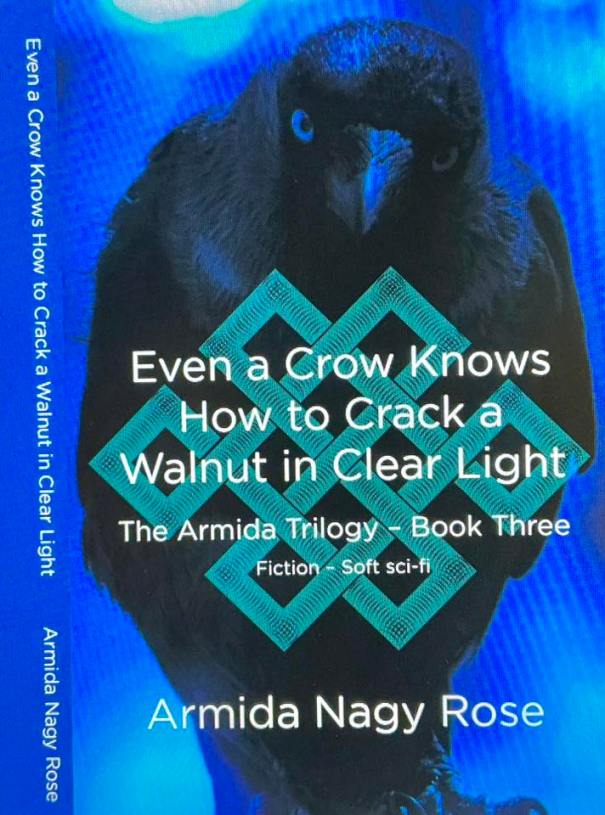
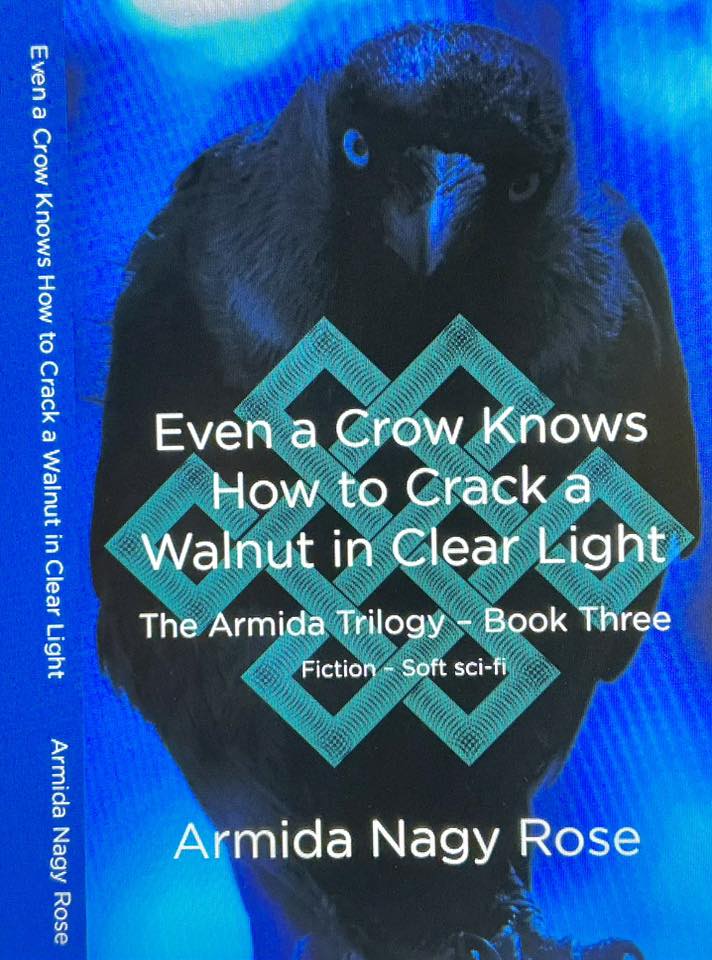
Author Armida Nagy Rose’s new book, Even a Crow Knows How to Crack a Walnut in Clear Light, is a riveting historical fiction novel with a brilliant heroine at its center.

Short Description

Released on March 10, 2026, Even a Crow Knows How to Crack a Walnut in Clear Light from Page Publishing author Armida Nagy Rose traces the life of a brilliant M.I.T. graduate, Ana, whose journey sets the stage for an exploration of the intersection of technology and spirituality. The novel touches on her childhood, highlighting her innate brilliance and her deep curiosity about the origins of the universe.


Armida Nagy Rose, a retired US Federal regulatory analyst, has completed her third book of the Armida Trilogy, Even a Crow Knows How to Crack a Walnut in Clear Light”: An exhilarating historical novel that follows the life of Ana, whose conflict ignites when she is recruited by a corporate headhunter working for a visionary consortium eager to reshape the world, using a unique contribution Ana developed while at the military research facility, Area 51.

Initially driven by a scientific obsession with light, Ana’s exploration gradually shifts toward deeper philosophical questions about existence itself. As her work evolves, she finds herself caught in a growing tension between the technological world she’s helping to create and an emerging awareness of a spiritual truth that transcends it. In this space, death is revealed as an illusion, and all beings and phenomena are seen as interconnected across the vastness of the universe.

Author

Armida Nagy Rose lives in Florida. A US citizen born abroad, she graduated from the University of Texas at Austin, Texas, and most of her career was under the US Department of Treasury and later under the US Department of Homeland Security when the Bush-Cheney reorganized major law enforcement agencies under DHS.

Armida writes, “A very pregnant Myra Ceagan Tošić-Tabbot enjoyed symbols appropriated from other cultures and from ancient peoples. On this day, she rested on a large Star of David that she drew on the porcelain-tiled patio with a light blue chalk. It was not easy; with her balloon of a belly, the roundness
indicated she would have a baby girl if all went well. She briefly recalled her first child, a stillborn boy named Boy Willard on the birth certificate, and her first husband, who died during her pregnancy when his EA-6B Prowler crashed in Washington State in 1982.”

She continues writing, “When she [Myra] drew the Star of David, she first drew the triangle that represents the male energy; and when she drew the feminine form, she rested on it, thinking her unborn would definitely be a girl. She would name her Ana. As a symbol, the name Ana meant gracious and satisfying. Satisfied, Myra thought would be an agreeable name to nurture her child abundantly.”

Published by Page Publishing, Armida Nagy Rose’s captivating tale takes readers into Ana’s world and beckons them to discover how her story unfolds.

Readers who wish to experience this thrilling work can purchase “Even a Crow Knows How to Crack a Walnut in Clear Light” at bookstores everywhere, or online at the Apple iTunes Store, Amazon, Google Play, or Barnes and Noble.
For additional information or media inquiries, contact Page Publishing at 866-315-2708.

Thoughts Beyond The Armida Trilogy–Symbols Matter .01

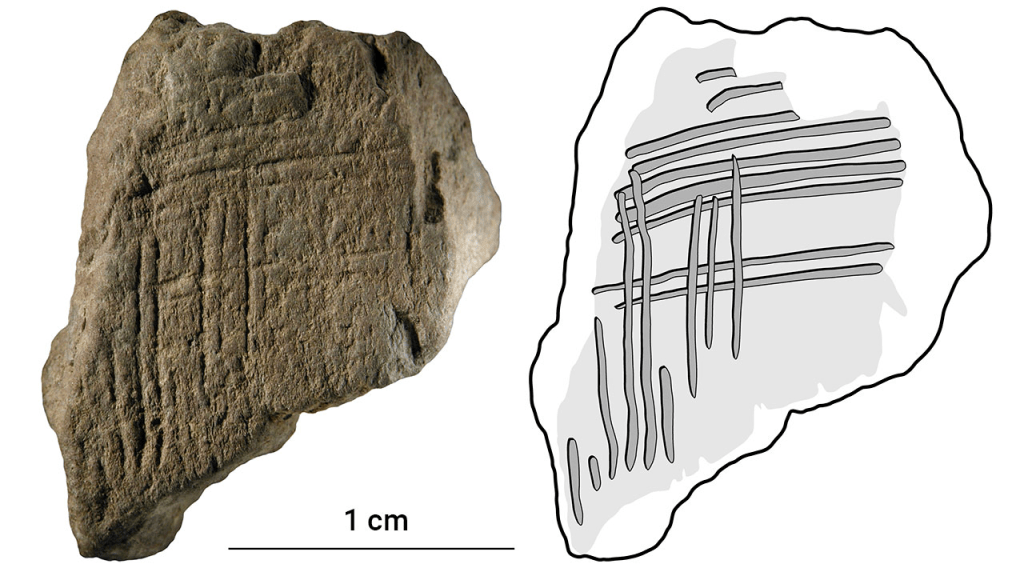
An early human scratched this hashtag pattern into a red ochre stone at Blombos Cave in South Africa. It is estimated to be about 100,000 years old. Source: Science.org

Can you imagine the first symbol a hominid made about 100,000 years ago? It appears to have been a hashtag? What could it have been like for him or her to make the first downward line on a hard surface? It was generated more than likely by a thought that then became a symbol.  Maybe it was to say, “This is one, this one is two,” ad infinitum. The curve, then the circle, followed by a spiral? In each case, each marking was a symbol to generate a mark.

So, what is symbol? A mark, sign, or word that represents an idea, object, color, relationship, or answer. Symbols as allegories are interesting. Every plot element in an allegory represents something in the story. For example, in Plato’s “Allegory of the Cave,” everything in the cave is an allegory—from the cave to the people, fire, shadows, and chains. Plato explained the allegory by saying that “Those who are able to see beyond the shadows and lies of their culture will never be understood, let alone believed by the masses.” He speaks to the ignorance of humanity trapped in the conventional ethics formed by society. 

In Buddhism, the cave is a metaphor used to illustrate the illusory nature of the material world.  The cave represents the human condition where individuals are trapped in a limited perception of reality.  The shadows cast on the cave wall represent the material world, which is a reflection of deeper truths that can only be understood through philosophical inquiry and enlightenment.

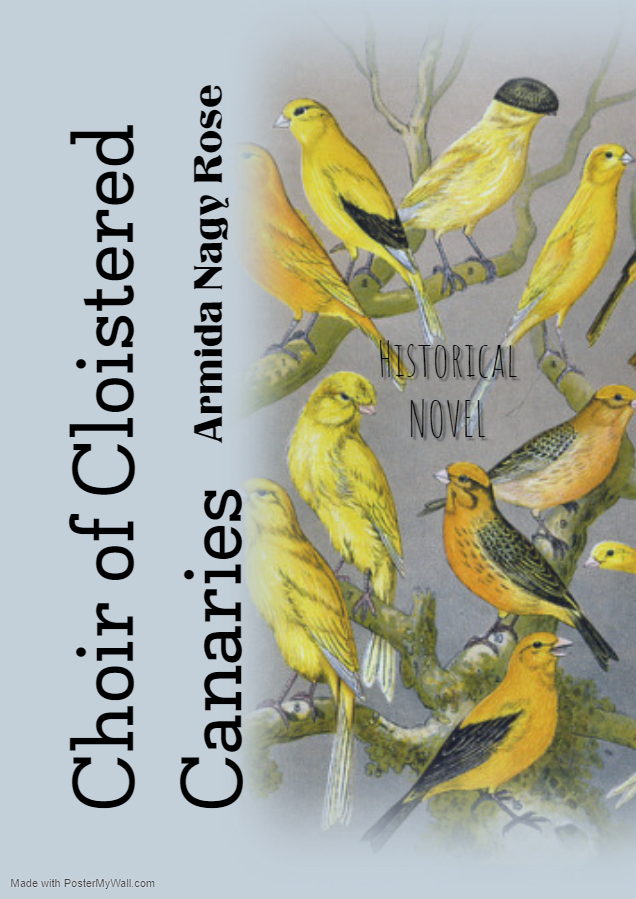
Albeit related to symbolism, a metaphor compares two seemingly unrelated things, stating that one thing is another. In the Armida Trilogy, there are several such metaphors; however, the three novels are laden with symbolism. In fact, each chapter of two of the books is introduced with a symbol. And, Book II offers a chart of the symbols as used in Choir of Cloistered Canaries.

 In the first chapter of Daughters of the Dance, long hair becomes a symbol of the first character—her long hair is likened to her headdress.  It was, in biblical times, a way of identifying an individual’s social status and cultural identity. For women in biblical times, long hair was associated with femininity, beauty, modesty, and submission to a higher authority (both the husband and God).

In Choir of Cloistered Canaries, water as a healing element is present to symbolize life and vitality, purity and renewal, emotional depth, spiritual significance, and cultural importance.  In case we forget, the average percentage of water in the human body is roughly 60%. The percentage range of water varies slightly, usually within a 50 to 75 percent range. Water, moreover, has many uses in chemical processes as a working fluid to convert heat energy to mechanical energy. There is historical reference as to how a historical woman, Maria Hebraea (c. 300 C.E.) who invented several kinds of chemical apparatus such as the bain-marie. She made distillation a new invention. Carl Jung used Maria’s axiom—“One becomes two, two becomes three, and out of the third comes s the one as the fourth”—as a metaphor for wholeness and individuation.  Afterall, Maria was known for her alchemy, the first known Western alchemist.

There is another analogy to Choir of Cloistered Canaries that is embedded in the title:  “Cloistered,” synonymous with “caged.” In Buddhism, the cage refers to the idea that the mind and body are like a bird in a cage. The bird sees that it is not able to fly freely, thus the metaphor illustrates a sense of disenchantment and the desire for liberation from suffering. Unlike our current environment where we have to put up and shut up, it becomes difficult to recognize that there is a way out of the cage.  Book Three addresses this conundrum or challenge.

The third book, Even a Crow Knows How to Crack a Walnut in Clear Light, uses the Star of David to highlight the lost memory of two acute angle triangles, one inverted over the other (the Mazzorath). It reflects an origin from the Vedic and Upanishadic India around the first half of the first millennium B.C.E. In early Indian thought, the two halves (or acute angle triangles described the primordial Self split into two parts (male and female). Later, the Yin-Yang concepts in Taoism came about as early as the 14th-13th century B.C.E.  The Yin represents moon energy associated with reflection, inner awareness, and sensitivity; the Yang represents the sun energy associated with activity, dynamism, and vitality. This lays the foundation of Ana and her mother to find agency in a world still governed by male conventions in the 21st century. Thus, the Armida Trilogy reflects the struggle of women as the setting and finally a resolution to the challenge of being human and feminine.

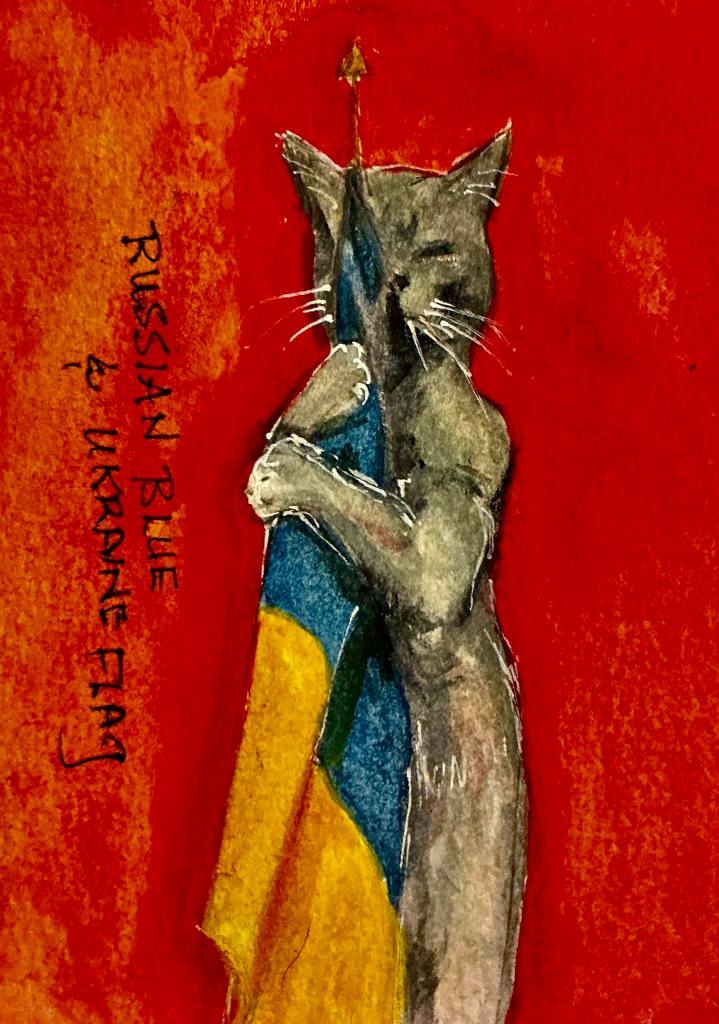
As a mental exercise on current events, how would you view what the following gallery of images portrays? What do they symbolize?

Book Three – Even a Crow Knows How To…

Even a Crow Knows How to Crack a Walnut in Clear Light; Space Includes All Beings and Things is a provocative novel that follows Ana, a gifted M.I.T. graduate, who becomes the nexus of a profound collision between cutting-edge technology and timeless spirituality.  From her early childhood, Ana’s innate brilliance and cosmic curiosity begin to unfold, setting her on a path that leads to the enigmatic depths of Area 51 and beyond.

Recruited by a visionary corporate consortium with orthodox ambitions to reshape the world. Ana’s expertise in military research became a gateway to deeper philosophical questions. As she navigates the intrigue of classified science and symbolic history, Ana began to question the very nature of existence.

The novel blends elements of literary nonfiction, romance, and metaphysical exploration.  Themes of interconnectedness, illusion, and liberation emerge as she discovers an inward path of truth: that death is not the end but a veil and that all beings and constructs are part of a vast conscious universe. The subtitle to the novel, Space Includes All Things and Beings, encapsulates this unveiling, inviting readers to consider a reality where science and spirit [one’s creative force] are not opposites but reflections of the same cosmic truth.

In Poetic Form

In the hush between equations and stars,
A girl name Ana listens—
To the hum of atoms,
To the silence of death,
To the mutter of crows.

Born brilliant, she maps the cosmos
With chalk and curiosity,
Her mind a telescope,
Her heart a cipher.

Recruited by shadows,
She crafts weapons for the world
That fears its own reflection.
But in the desert of secrets,
Direction blooms like the prickly wild rose.

She begins to see—
Not with eyes
But with her spirit’s aperture
That death is a doorway, not a wall,
That space is neither empty or emptiness
But infinite with presence.

And even a crow,
Black-winged and laughing,
Knows that—
All things are one,
All things belong,
And all things spiral toward light.