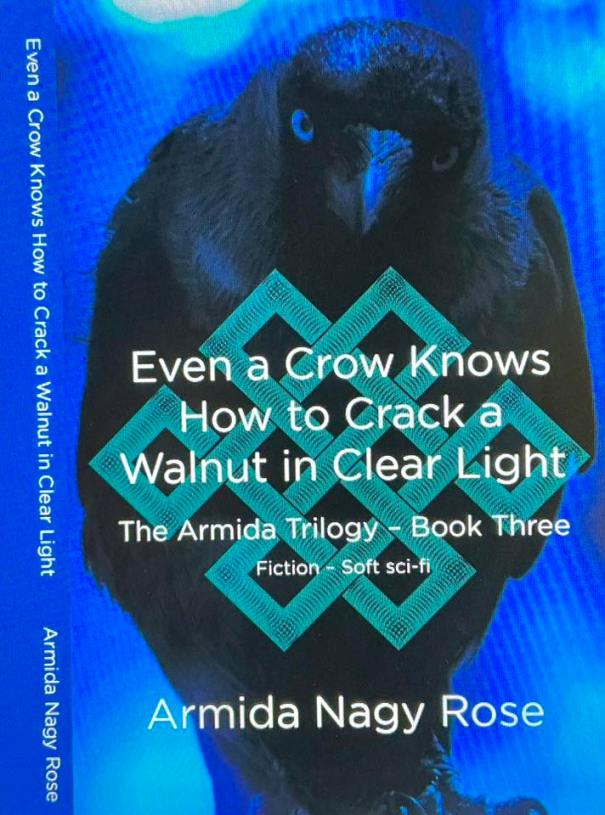
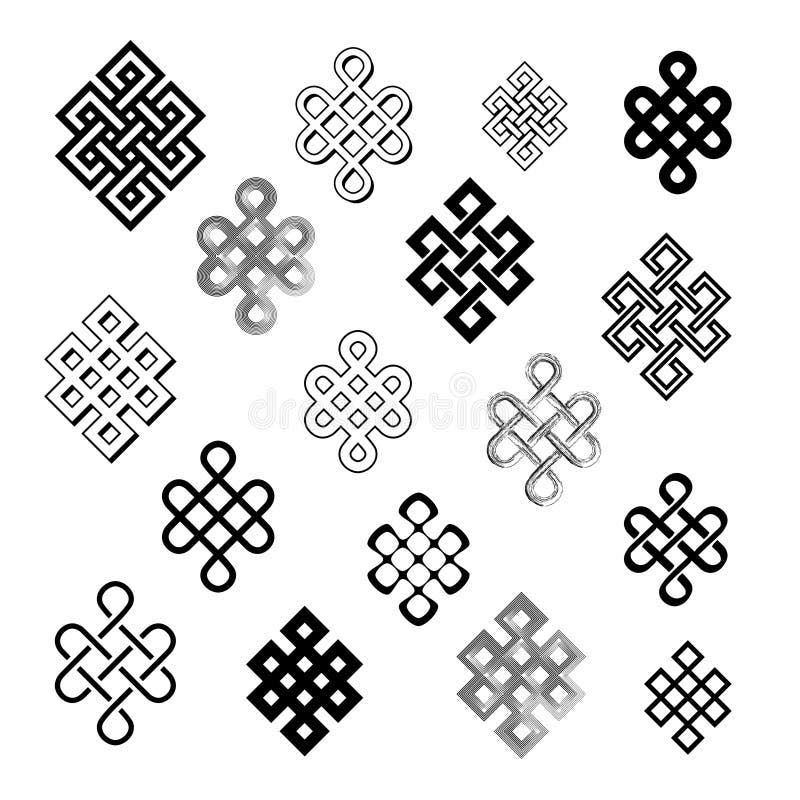
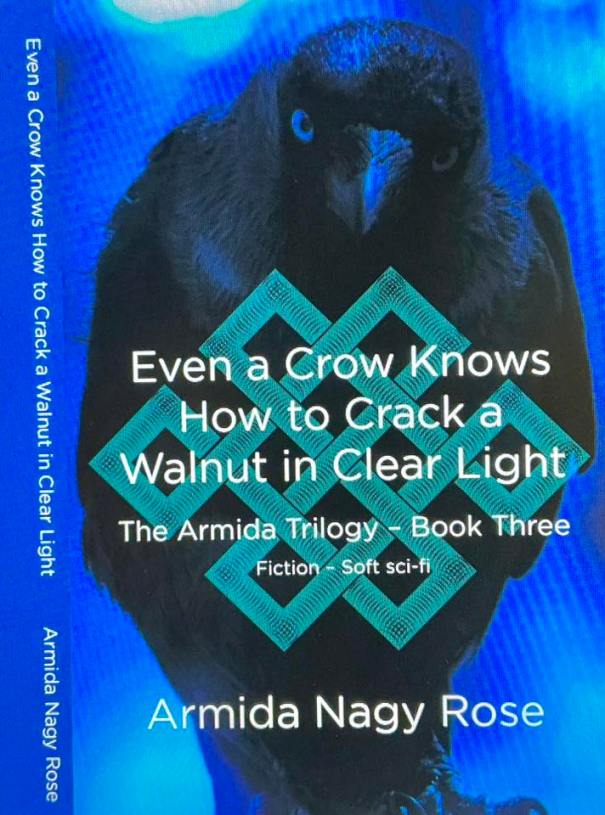
It may be safe to say that the novel Even a Crow Knows How to Crack a Walnut in Clear Light is undergirded by subtle Eastern philosophical views. For this reason, the the “endless knot” appears on the front and back cover of the book.
Known also as the “eternal knot,” it is a symbol that features a closed, looped design with no beginning or end. You may have seen it in Chinese art and knots, but it is a cultural market where Tibetan Buddhism is influential. We can even think it is somewhat like a torus in which the surface revolves as a continuous circle in three-dimensional space that creates a system that maximize grid capacity by storing excess electricity and by deploying the electrical charge when needed, thus aligning power generation as demanded.
On the other hand, the “endless or eternal knot” speaks of such energy in spiritual terms such as infinite wisdom and compassion, the interconnectedness of all phenomena, and the continuity of life, death and rebirth. Before indulging in the symbolic meanings, usage, and context of this symbol, please view the following link to know how this novel connects western and eastern philosophies, and modern physics. There are several philosophical/physics thoughts are injected in Even the Crow Knows….
Interdependence: Also known as dependent origination, it shows that all phenomena are interconnected and rely on causes and conditions.
Union of Wisdom and Compassion: The intertwined, inseparable nature of wisdom and method as compassion, are essential for enlightenment.
Endless Cycle: The union of opposites (e.g., calm and movement, Tao, yin-yang) and the dominant cycle of rebirth.
Buddha Shakyamuni’s Teachings: Remarkable teaching that manifest as boundless, omnipresent wisdom.
Usage and Context: Serves as a common cultural marker, art, amulets, and in sacred geometry to sere as a meditative focus on non-duality and unity.
Lastly, the knot, although slightly different in designs, is found in Hindu, Jain, and Celtic traditions, often signifying eternity or longevity. In ancient India, it was a symbol of auspiciousness and harmony.
As stated by Bulgarea Candin Stefan, “Interestingly, the religious symbol of the Eternity Knot is said to represent the interdependence between secular and religious matters. Originally, this symbol was associated with Vishnu and his abiding love for his consort Lakshmi, goddess of prosperity and wealth. You can find the endless knot symbol on various inspirational products such as infinite knot decor, infinite knot pendant, and more.
“Knots are certainly deeply rooted in our consciousness as archetypes.”
The author, however, implies that it represents the physics of the Tao’s yin-yang of Quantum Theory.
The author of the first two books of The Armida Trilogy, revisits Panama as a source of insights into the varied cultures and historical contexts of the area as a major trading post in world affairs.
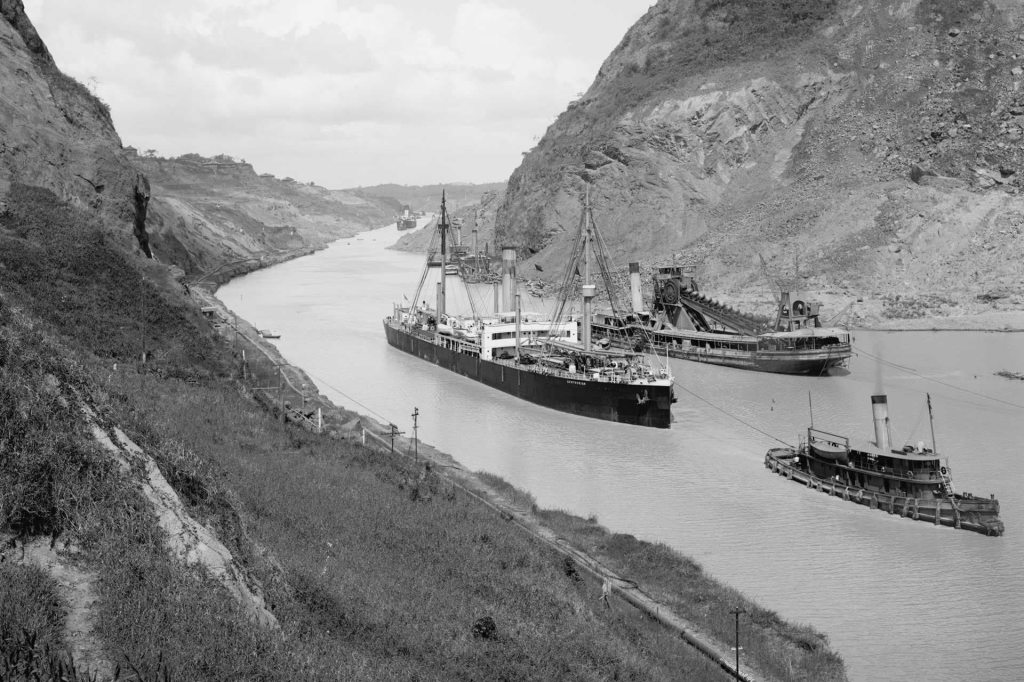
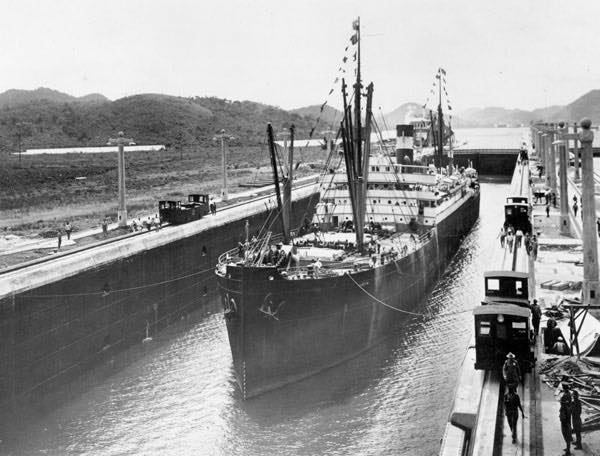
The Panama Canal Zone was a U.S.-controlled territory by the U.S. Corps of Engineers in the Republic of Panama from 1903 to 1979. It took over the French in building the canal and then to operate and to maintain the Panama Canal. It then became known as the Zona del Canal de Panama–a strip of land across the Isthmus of Panama, approximately 50 miles ling and extending about five miles on either side of its centerline, excluding Panama City, and Colon. The administrative center of the US-controlled territory was Balboa, Canal Zone.
To this day, the Panama Canal is a critical artery for global trade, significantly reducing shipping times and cost. But it also serves as a strategic asset for the United States and in influencing geopolitical dynamics.
Under the Hay-Bunau-Varilla Treaty of 1903, Panama, following its independence from Colombia, granted the United States to exercise authority within the Canal Zone as if it were sovereign.
In exchange Panama received $10 million and an annual annuity of $250,000, enabling the United State to construct and to operate the Canal Zone without interference from Panamanian authorities. As a strategic waterway, it connected the Atlantic and Pacific Oceans. Its presence shortened maritime travel by thousands of nautical miles, thus avoiding the dangerous route around Cape Horn, the southernmost headland of the Tierra del Fuego archipelago of southern Chile. (Even the Crow Knows… takes the readers to this area of Latin America instead of Panama.)
The US Canal Zone was abolished on October 1, 1979, under the Torrijo-Carter Treaties, which returned administrative control to Panama. A transition period was agreed upon between Panama and the United States, allowing the latter to pull out its military bases and civilian corps until December 31, 1999. This period also arranged for the United States personnel to train the Panamanians on how to operate the Canal Zone. A little known fact about the end of U.S. presence was the courts found that the United States had violated its original treaty by not allowing joint administration of the Canal Zone from its inception! Another unknown fact was that the American business community lobbied the U.S. Congress because of its maritime concerns and reputation.
The idea of a canal across the Isthmus of Panama was soon formulated after the Spanish conquest of the area in 1529. It was a lieutenant of conquistador Vasco Nunez de Balboa by the name of Alvaro de Saavedra Ceron who suggested it. But the serious attempt (1880-1889) to build a sea-level canal came from Ferdinand de Lesseps, the French engineer who had successfully built the Suez Canal. Its completion failed due to disease, terrain, and antisemitism at home that led to financial problems.
The current affair of the Panama Canal Zone has become a political football. The 47th President of the United States has publicly vowed to “take back” the Panama Canal from Panama and claimed China controls it. However, in practice, the Panama Canal is still run by the canal authority of Panama and remains legally Panamanian.
Who controls the canal right now
The Panama Canal has been under full Panamanian sovereignty since the Torrijos–Carter Treaties were completed in 1999, and it is operated by the autonomous Panama Canal Authority (ACP), not by the U.S. or China.
Panama’s constitution and a separate neutrality treaty state that the canal must remain neutral and open to all nations in peace and war, with Panama responsible for its administration and security.
US 47th President claims and actions
THIS IS HOW THE WATERS GOT MUDDIED!
Since returning to office, the 47th President has repeatedly said that the given away and alleging that China “operates” or “controls” it. and nearby infrastructure.
China does not operate the canal itself, but Chinese-linked companies from Hong Kong have held long-term concessions at ports on each end of the canal and have invested in related logistics and infrastructure in Panama.
U.S. officials close to the US President argue that this presence could be used to pressure or disrupt U.S. shipping in a crisis, which is part of why the administration is pushing back diplomatically and economically.
Response of Panama
Panamanian President José Raúl Mulino and the ACP have rejected the US Administration’s assertions, insisting that Panama alone runs the canal, that fees are applied equally to all ships, and that there is no Chinese operational control. Mulino has said there is “no possibility” of negotiating any transfer of ownership back to the United States and has stressed that Panama intends to uphold the canal’s neutrality.
Legal and practical status
Under current treaties, the U.S. has a right to help defend the canal’s neutrality but no right of ownership or routine operational control; any U.S. move to “take it back” without Panama’s consent would violate Panamanian sovereignty and established international norms.
So as of now, the “status” is: Trump is applying political, military‑planning, and economic pressure around the canal, but control in law and in day‑to‑day operation remains with Panama, not with the U.S. or China.
As of this first week in March 2026, the U.S. President claimed he got rights over the Panama Canal for $1.00. That is hard to believe. In February 2026, under U.S. pressure, Panama seized two ports previously run by a joint Hong Kong-UK company. This was a Panamanian government action, not a U.S. purchase, and it still did not give the U.S. control of the canal.
There is zero reporting of any sale, transfer, or lease of the Panama Canal to Trump or the U.S. for any amount. The canal remains under the control of the Panama Canal Authority, as established by the 1999 Torrijos–Carter Treaties.
INTRODUCINGTHE ARMIDA TRILOGY withBook Three: SOFT SCIENCE FICTION,EVEN A CROW KNOWS HOWTO CRACK A WALNUT IN CLEAR LIGHT (2026)
THE ARMIDA TRILOGY | Daughters of the Dance – Book One (2018),
Choir of Cloistered Canaries – Book Two (2020), and
Even a Crow Knows How to Crack a Walnut in Clear Light – Book Three (2026)
The Armida Trilogy — A Multigenerational Odyssey of Feminine Power
The fictional works of The Armida* Trilogy are all interconnected by the central theme of women’s issues in the midst of adversities across various historical contexts. The narratives feature protagonists from different generations, with the first novel focusing on three women, the second on two, and the third on a single individual.
These works blend elements of intellectual discourse, philosophy, intrigue, symbolism, history, travel, and romance, incorporating some brief aspects of literary nonfiction. Each novel conveys messages about determined women navigating their spiritual journeys within specific historical frameworks and with their development influenced by contemporary events. The Armida Trilogy spans from the turn of the 19th century to the early 21st century and introduces central protagonists Dara, Ayana, Nona, Isobel, Leitis, Thelma, Myra, and Ana as they play out their archetypes as Creatrix, Lover, Maiden, Mother, Mystic, Warrior, and the like.
Spanning over two centuries, The Armida Trilogy is a sweeping literary journey that interlaces the lives of at least nine women across three novels, each navigating the crucible of her era. From the twilight of the Enlightenment to the dawn of the digital age, these embody timeless archetypes such as the Creatrix, the Lover, the Mystic, and the Warrior. Their stories unfold against the backdrop of historical upheaval, philosophical awakening, and intimate personal reckonings.
Each novel narrows its focus: the first weaves the lives of three women into a collective chorus of resistance and awakening; the second deepens into the duality of two intertwined fates; the final novel distills the journey into the singular voice of a woman confronting the legacy of those before her. Through intellectual discourse, symbolic motifs, and romantic undercurrents, the trilogy explores how women shape — and are shaped by — the world around them.
Blending fiction with glimmers of literary nonfiction, The Armida Trilogy is not just only a chronicle of survival but also a celebration of spiritual evolution, intergenerational wisdom, and the enduring power of the feminine spirit.
Though the trilogy uses the author’s birth name per se, The Armida Trilogy, is named after a fictitious character, Armida, in Torquato Tasso’s epic poem, Gerusalemme Liberata (1591). with historical and literary connections: A Damascus warrior-queen from the 1st Crusade. Tasso inspired numerous artists and composers, each interpreting Armida’s character in unique ways. As such, she embodies the archetype of the forsaken woman in literature. Yet, many view Armida as a more relatable and sympathetic figure, adding depth to her portrayal.
BOOK THREE – Even a Crow Knows How to Crack a Walnut in Clear Light. (2026)
Despite its playful title, Even a Crow Knows… introduces a gifted M.I.T. graduate, whose life sets the foundation for the novel’s exploration of the clash between technology and spirituality. It touches on her early childhood, when her natural brilliance and curiosity about the universe first began to take shape.
The narrative introduces the overarching conflict—Ana’s recruitment by a corporate headhunter for an orthodox, visionary consortium focused on reshaping the world with her military research experience at Area 51. And Ana’s scientific fascination eventually merges with deeper philosophical questions about the nature of existence.
The background themes of the novel include elements of military research, philosophy, intrigue, symbolism, history, and romance, incorporating literary nonfiction. Ana’s growing realization of a spiritual truth—when death is perceived as an illusion and where all beings and constructs are interconnected in the vast expanse of space— one can reach self-liberation. After all, the subtitle states Space Contains All Beings and Things.
BOOK ONE – Daughters of the Dance (2018)
Aa multi-generational saga of women dancers, specifically the danse du ventre, against a backdrop of global upheaval within the context of the Sephardic-Ladino community of professional men of Curaçao, this historical novel is rich in its cultural tapestry, spiritual symbolism, and mature sexual boundaries. At once, it’s a historical epic, spiritual journey, and intimate portrait of female embodiment.
Renewed interest in Daughters of the Dance, the first book under The Armida Trilogy, this press release offers an overview of Armida Nagy Rose’s historical novel originally published in August 2, 2018. Originally written as a screenplay, Nagy Rose later expanded it into this novel to incorporate richer historical and cultural detail of the Sephardic Jews of Curacao…
Set across the first half of the 20th century, the noel spans three generations of women in two interconnected families—mothers, daughters, and granddaughters—who practice the art of dance, specifically danse du ventre (Moyen-Orient), against a backdrop of global upheaval. The other family involved three affluent Sephardic brothers.
The story revolves around Dara, an Algerian expatriate whose sensuous belly-dancing garners both admiration and scandal in Europe and in the Americas during World War II. Her daughter, Ayana, and later her granddaughter, continue this heritage. Through these spiritual daughters of the dance, the fast-moving narrative explores topics of sexuality, spiritual liberation, and female empowerment
The following provides key themes (historical and cultural tapestry, spiritual symbolism, and controversial adult content).
The plot weaves through settings that include the Netherlands, Panama, Spain, Mexico, and Willemstad, Curacao—all within the context of the Sephardic-Ladino Jewish diaspora and the expansions and tremors of war.
Moreover, dance in the novel is not just performance. It is a spiritual discipline to “dance in the middle of the fighting, dance in your blood, dance when you are perfectly free,” a partial quote of a Sufi poem by Rumi (13th century C.E.). As a theme, the narrative connects dance with themes of redemption, freeing of the self, and breaking cycles of rebirth (the cycle of samsara), weaving in Buddhist notions like the Bardo (the intermediate state of death and rebirth).
Consequently, the novel delves into mature themes—sexual boundaries, relational power, religious conservatism, and suppression of women—providing both a sensual and cerebral experience.
Daughters of the Dance thought-provoking themes around female agency, sexuality, and liberation is both sensual and symbolic storytelling.
In essence, this historical novel is an ambitious, provocative sage of women seeking their agency—literally through dance, spiritual ecstasy, and introspection—amid social, religious, and wartime constraints. In short, it is at once a historical epic and an intimate portrait of female embodiment.
BOOK TWO – Choir of Cloistered Canaries (2020) – a thought-provoking, multi-layered novel that fuses epidemiology and psychology with ancient symbolism, environmental activism, and mystical exploration – wrapped in an emotionally-grounded take of reconnection, love, and resistance against ethical erosion. It uses the canary as metaphor to champion environmental guardianship and justice for all.
Anyone who is interested environmental justice when science meets spirituality would be attracted to the environmental appeal and intellectual adventure.
Leitis Dennett, a senior CDC epidemiologist about to retire, is called to a secretive laboratory at the North Carolina Research Campus to reconnect with her estranged mother of several decades. As a member of the CDC Rapid Response Team, her visit to her mother is cut short to join the team headed for The Vatican and Rome, Italy. It is there that a fortuitous relationship with Pope Hormisdas II develops.
Anyone who is interested environmental justice when science meets spirituality would be attracted to the environmental appeal and intellectual adventure.
Leitis Dennett, a senior CDC epidemiologist about to retire, is called to a secretive laboratory at the North Carolina Research Campus to reconnect with her estranged mother of several decades. As a member of the CDC Rapid Response Team, her visit to her mother is cut short to join the team headed for The Vatican and Rome, Italy. It is there that a fortuitous relationship with Pope Hormisdas II develops.
It is also at this journey that she meets a medical engineer who joins her to further improvements on public health and to combat environmental degradation, echoing President Eisenhower’s warning in 1961 against unchecked industrialization and over consumption.
The novel resonates with modern concerns—clean air, water, and earth—representing “our song as canaries,” a metaphor for how human signal ecological distress. Leitis blends her epidemiology expertise with her passion for comparative mythology and alchemy, searching for hidden meanings in ancient symbols.
Beyond global stakes and politics, the novel is deeply personal—a mother and daughter healing almost a half-century of separation.
If you are drawn to environmental activism, ethical science, and storytelling where ancient wisdom meets modern dilemmas, this novel delivers. Even as a human story, it is framed within larger questions of mortality and stewardship.
In summary, Choir of Cloistered Canaries blends a personal mother-daughter reunion with a global quest to expose and counteract corporate greed, sacred symbolism, and environmental collapse. It asks readers to listen to the Earth’s “canary” warnings.
ABOUT THE AUTHOR – Armida Nagy Rose is a reclusive, multidisciplinary artist and writer who publishes fiction under a nom de plume. Her work moves effortlessly between visual art, poetry, and narrative fiction, fusing spiritual inquiry, cultural history, and embodied practice into stories and workshops that invite close attention and quiet transformation.
Born into a family steeped in diasporic histories and contemporary religious beliefs, she developed an early fascination with myth, movement, and the material traces of memory. Her visual work—acrylics, watercolors, and pen-and-ink drawings—earned regional recognition when she was named Artist of the Month by the North of Tampa Arts League in the early 2000s. She also served on the board of the Coalition of Hispanic Artists in Hillsborough County, organizing community exhibitions that paired archival research with contemporary visual experiments.
As an educator, Armida created Zen Tango Art: Meditative Drawing in Pen & Ink, a practical manual published in 2011 that pairs intuitive mark-making (doodling) with focused observation (negotiating a representational object with doodling aesthetics) and contemplative attention. She led workshops that translate the book’s techniques into accessible exercises for artists, writers, and people seeking art as a mindfulness practice.
Her literary output spans poetry, short prose, and longer fiction. Early poems such as “Abraham Revisited” and visual pieces appear in anthologies such as Waves of Wonder and Reflections: The Olli-USF 20th Anniversary Collection, where she contributed both prose and imagery. Several early essays and art pieces were published online between 2012 and 2013. The International Library of Poetry, 2002, “Ode to the Gaian Pie”. Some of her early writings (2012-2013) are posted at thought4though.wordpress.com.
She has also taught introductory “Quintessential Tibetan Buddhism” at the Osher Lifelong Learning Institute at the University of South Florida. Working from an initial screenplay for Daughters of the Dance, having trained in belly dance for several years, she expanded her narrative vision into The Armida Trilogy, a multi‑generational sequence of novels that interweaves history, comparative mythology, and spiritual symbolism to examine women’s agency across three centuries.
Armida’s fiction is characterized by richly textured settings, ethically engaged protagonists, and an interest in the body as archive and ritual. Her first novel, Daughters of the Dance, reframes the danse du ventre as spiritual discipline and a cultural memory within Sephardic‑Ladino networks. Book Two, Choir of Cloistered Canaries, blends epidemiology, environmental activism, and mysticism to ask how science and spirituality might together defend the commons.
Despite her private nature, Armida has participated in public life through curated lectures, intimate salons, and virtual conversations that pair historical scholarship with embodied practice until she became afflicted by multiple chemical sensitivities (MCS). Since 2009, she became an advocate of living a life that reduces exposure to toxic chemicals, primarily, those that are derived from petroleum. The novel, Choir of Cloistered Canaries, broaches this theme in a limited manner, since ambient and indoor air pollution is a major cause of premature deaths worldwide..
Armida lives and works in the southeastern United States. She continues to paint, draw, and write into her eighties and has developed a new fiction that explores the intersections of ritual, ecology, and female creative power.
Author Armida Nagy Rose’s new book, Even a Crow Knows How to Crack a Walnut in Clear Light, is a riveting historical fiction novel with a brilliant heroine at its center.
Short Description
Released on March 10, 2026, Even a Crow Knows How to Crack a Walnut in Clear Light from Page Publishing author Armida Nagy Rose traces the life of a brilliant M.I.T. graduate, Ana, whose journey sets the stage for an exploration of the intersection of technology and spirituality. The novel touches on her childhood, highlighting her innate brilliance and her deep curiosity about the origins of the universe.
Armida Nagy Rose, a retired US Federal regulatory analyst, has completed her third book of the Armida Trilogy, Even a Crow Knows How to Crack a Walnut in Clear Light”: An exhilarating historical novel that follows the life of Ana, whose conflict ignites when she is recruited by a corporate headhunter working for a visionary consortium eager to reshape the world, using a unique contribution Ana developed while at the military research facility, Area 51.
Initially driven by a scientific obsession with light, Ana’s exploration gradually shifts toward deeper philosophical questions about existence itself. As her work evolves, she finds herself caught in a growing tension between the technological world she’s helping to create and an emerging awareness of a spiritual truth that transcends it. In this space, death is revealed as an illusion, and all beings and phenomena are seen as interconnected across the vastness of the universe.
Author
Armida Nagy Rose lives in Florida. A US citizen born abroad, she graduated from the University of Texas at Austin, Texas, and most of her career was under the US Department of Treasury and later under the US Department of Homeland Security when the Bush-Cheney reorganized major law enforcement agencies under DHS.
Armida writes, “A very pregnant Myra Ceagan Tošić-Tabbot enjoyed symbols appropriated from other cultures and from ancient peoples. On this day, she rested on a large Star of David that she drew on the porcelain-tiled patio with a light blue chalk. It was not easy; with her balloon of a belly, the roundness indicated she would have a baby girl if all went well. She briefly recalled her first child, a stillborn boy named Boy Willard on the birth certificate, and her first husband, who died during her pregnancy when his EA-6B Prowler crashed in Washington State in 1982.”
She continues writing, “When she [Myra] drew the Star of David, she first drew the triangle that represents the male energy; and when she drew the feminine form, she rested on it, thinking her unborn would definitely be a girl. She would name her Ana. As a symbol, the name Ana meant gracious and satisfying. Satisfied, Myra thought would be an agreeable name to nurture her child abundantly.”
Published by Page Publishing, Armida Nagy Rose’s captivating tale takes readers into Ana’s world and beckons them to discover how her story unfolds.
Readers who wish to experience this thrilling work can purchase “Even a Crow Knows How to Crack a Walnut in Clear Light” at bookstores everywhere, or online at the Apple iTunes Store, Amazon, Google Play, or Barnes and Noble. For additional information or media inquiries, contact Page Publishing at 866-315-2708.
We often think that a random headache or brain fog is temporary. There is, however, a source that causes the temporary malady. One should not take these events lightly, especially when they tend to recur. In this case, one should become hyperalert. For some time now, we need to not trust that all manufacturers are trustworthy. Trustworthiness in the chemical manufacturing industry is complex, featuring a mix of highly-regulated, specialized, and reliable firms alongside instances of corporate negligence and, in some cases, deliberate suppression of health data.
The main “ingredient” in chlorpyrifos products is the technical‑grade active substance (chlorpyrifos technical), which is manufactured and supplied in bulk primarily by large agrochemical producers in China and India, with some legacy production from multinationals such as Dow/Corteva and others.
How chlorpyrifos is sourced
Chlorpyrifos was originally developed and first produced commercially by Dow Chemical (later Dow AgroSciences, now part of Corteva), which for decades was one of the principal global manufacturers supplying technical‑grade chlorpyrifos to formulators.
Over time, production expanded globally; current reports note that China and India are now two of the biggest producers of chlorpyrifos, with large volumes exported as technical material to other countries where it is formulated into end‑use products.
A risk‑profile and NGO country‑situation reports list Dow AgroSciences (USA and UK), Makhteshim (Israel, now part of ADAMA), FMC (USA), and Cheminova (Denmark, now also under FMC/ADAMA ownership) among approved or recognized sources for import of chlorpyrifos technical into markets such as India.
In the current market, there are hundreds of suppliers and distributors of chlorpyrifos products globally, but most do not synthesize the molecule themselves; instead, they buy chlorpyrifos technical (the main active ingredient) from large technical‑grade manufacturers—predominantly in China and India—and then formulate and package it (e.g., 50% EC, 50% WP, granules) for sale.
If you are looking for “who sources what from whom” in a specific country or for a particular brand (e.g., which technical supplier a given U.S. registrant uses), that usually requires looking at that company’s registration dossiers, import approvals, or trade data, which can sometimes be pulled from regulatory filings or subscription market reports rather than public summary pages.
What are the main raw materials used to synthesize chlorpyrifos?
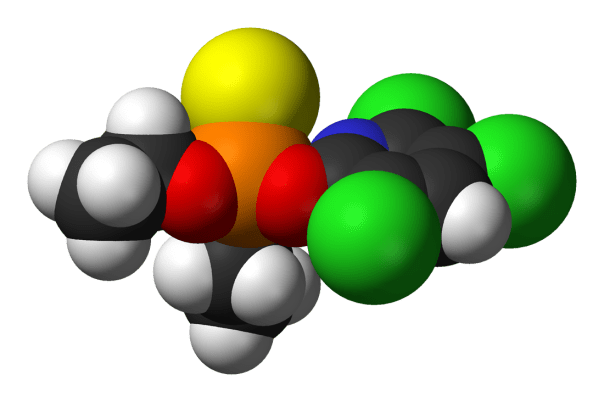
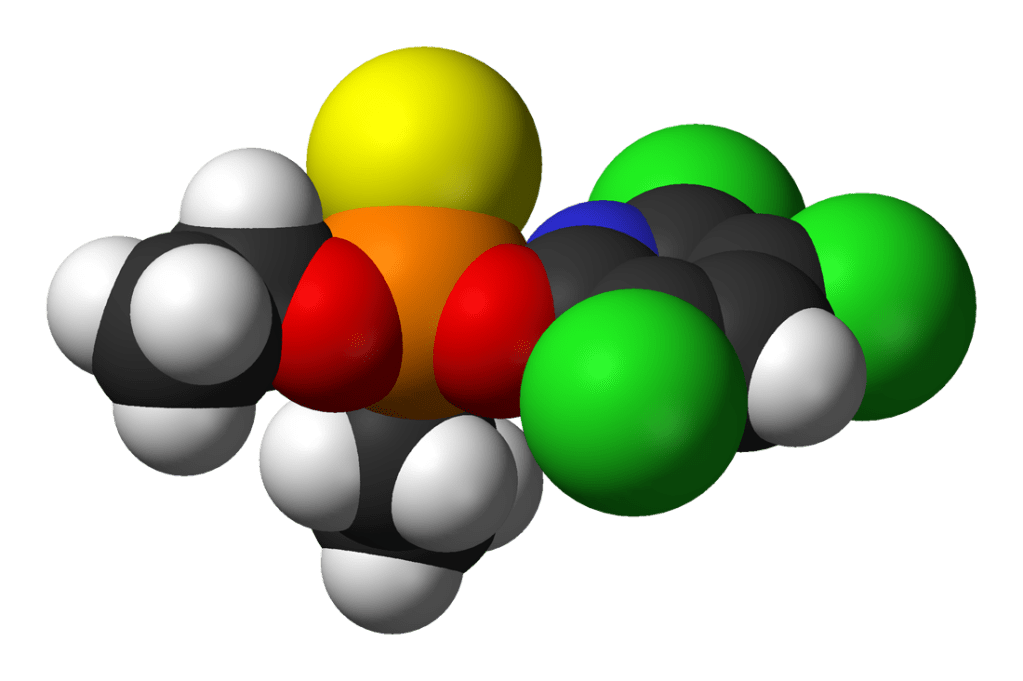
Chlorpyrifos is built from a chlorinated pyridine ring and a diethylthiophosphate group, so the key raw materials are the precursors to those two pieces.
Core starting materials (conceptual)
In standard industrial routes, the main raw materials are:
A substituted pyridine starting material (commonly 3‑methylpyridine / 3‑picoline or related pyridine derivatives), which is then chlorinated and transformed into 3,5,6‑trichloro‑2‑pyridinol (often called TCP).
A phosphorus oxychloride–type reagent that ends up as O,O‑diethylphosphorochloridothioate (the diethylthiophosphate chloride used to introduce the organophosphate side).
Ethanol (or another C2 alcohol source) to form the diethyl ester part of the thiophosphate.
Chlorinating agents (such as chlorine or other chlorinating systems) used to introduce the three chlorine atoms onto the pyridine ring.
Sulfur/thiation reagents (or sulfur dichloride / related sulfur chlorides in some routes) to convert a phosphorochloridate into the corresponding phosphorochloridothioate (P=S).
Bases and caustic alkali (e.g., sodium hydroxide, sodium carbonate) to generate the phenoxide (pyridinol salt) and to neutralize HCl during coupling.
Immediate precursors to technical chlorpyrifos
Focusing on the last synthetic step that actually yields chlorpyrifos, the two “main” raw materials are usually:
These are reacted under basic conditions so that the pyridinol (as its sodium salt) attacks the phosphorus center, displacing chloride and forming chlorpyrifos.
How is 3,5,6-trichloro-2-pyridinol produced
Industrial production of 3,5,6‑trichloro‑2‑pyridinol (TCP) uses chlorinated pyridine routes or “chloroacrylonitrile” routes, but all converge on building and then selectively chlorinating a pyridinol ring.
A widely cited process (Dow patent) prepares TCP from simple chlorinated C2 building blocks:
Trichloroacetyl chloride is reacted with acrylonitrile to form 2,2,4‑trichloro‑4‑cyanobutanoyl chloride (an adduct).
This adduct is cyclized under acidic conditions to give a dihydropyridone (3,3,5,6‑tetrachloro‑3,4‑dihydropyridin‑2‑one).
The dihydropyridone is then aromatized (dehydrogenated) to 3,5,6‑trichloropyridin‑2‑ol (TCP), and the product is isolated by standard workup (acidification, phase separation, solvent removal).
In this route, the effective “raw materials” for TCP are trichloroacetyl chloride, acrylonitrile, an acid catalyst, and solvent.
Alternative chlorination / demethoxylation routes
Other patented processes start from partially chlorinated pyridines and then introduce additional chlorine atoms:
2‑chloro‑6‑methoxypyridine is first subjected to acid‑catalyzed ether cleavage (with concentrated HCl) to give 6‑chloro‑1H‑pyridin‑2‑one.
Without isolation, an aqueous carboxylic acid (e.g., acetic acid) is added and chlorine gas is passed through the headspace, chlorinating the ring to 3,5,6‑trichloro‑1H‑pyridin‑2‑one (i.e., TCP).
A separate family of routes chlorinate 2,3,5,6‑tetrachloropyridine under basic conditions (NaOH, phase‑transfer catalyst) and then partially hydrolyze to give 3,5,6‑trichloro‑2‑pyridinol.
These approaches use 2‑chloro‑6‑methoxypyridine or 2,3,5,6‑tetrachloropyridine plus hydrochloric acid, carboxylic acid, chlorine gas, sodium hydroxide, water, and a phase‑transfer catalyst (e.g., TBAB).
Summary of main intermediates
Across commercial routes, TCP is typically obtained via:
Formation of a chlorinated dihydropyridone intermediate from trichloroacetyl chloride and acrylonitrile, then cyclization and aromatization.
Or chlorination/hydrolysis of pre‑formed chloropyridine derivatives such as 6‑chloro‑1H‑pyridin‑2‑one or 2,3,5,6‑tetrachloropyridine.
How is TCP purified after synthesis
After synthesis, 3,5,6‑trichloro‑2‑pyridinol (TCP) is typically purified by phase separation, acid–base workup, and one or more crystallization/drying steps.
Typical industrial workup
The crude reaction mixture is first neutralized or adjusted to a basic pH (often with NaOH or KOH), which converts TCP to its water‑soluble sodium or potassium salt and separates organic and aqueous phases; the solid catalyst (if used) is filtered off.
The aqueous phase containing TCP salt is then acidified (e.g., with sulfuric acid) to around pH 2, which precipitates TCP as a solid that can be isolated by filtration.
The wet cake is washed with water to remove inorganic salts and residual acids/bases, then dried (tray dryer, vacuum dryer, or similar) to yield technical‑grade TCP.
Crystallization and polishing
For higher purity, TCP (or its sodium salt) may be recrystallized: the crude solid is dissolved in hot water or a suitable solvent, then the solution is slowly cooled so TCP crystallizes; the crystals are collected by filtration and dried.
Some processes include solvent extraction (e.g., methanol/ethanol extraction of the sodium salt followed by solvent distillation) to remove organic impurities before final drying.
In practice, a producer will tune pH, temperature, and solvent choice so TCP precipitates cleanly, filters easily, and reaches the purity needed for downstream chlorpyrifos manufacture.
Febreze, the “Scent Reward”
Once a failed product, it became a household staple by marketers shirting the focus from removing odor to providing a satisfying “scent reward.” That’s to say, consumers are taught to buy emotional, sensory experiences over technical, functional benefits.
The “torus” or donut‑shaped molecule in Febreze is a modified cyclodextrin, most commonly hydroxypropyl‑β‑cyclodextrin (HPβCD), which is a ring made of sugar units derived from starch (typically corn).
However, the main ingredient, hydroxypropyl‑β‑cyclodextrin (HPβCD), as a compound, one must consider this: toxicity level + route = condition of patient. It is toxic. Though it is considered low in toxicity when used at “safe levels” (an unknown factor), it is known to tress the kidneys and can accumulate in patients with kidney impairments. Under some extreme exposures, it can cause renal toxicity, including kidney tubular damage, liver changes, and ototoxicity (hearing changes).
What the self-regulating torus molecule is
The core structure is β‑cyclodextrin, a cyclic oligosaccharide made of seven glucose units linked in a ring.
In many Febreze formulations, this ring is chemically modified to hydroxypropyl‑β‑cyclodextrin (HPβCD) to improve solubility, delivery, and performance.
Chemical makeup at a simple level
At the level of “what chemicals” form the torus:
Each ring unit is a glucose molecule (formulaC6H12O6), so unmodified β‑cyclodextrin is essentially seven glucoses linked together (overall formula C42H70O35).
The hydroxypropyl modification adds small hydroxypropyl groups (–CH2–CHOH–CH3) onto some of the hydroxyl (–OH) sites on those glucose units; the exact number and positions vary, so HPβCD is a mixture of similar molecules rather than one single, fixed molecular formula.
How the torus behaves chemically
The outside of the ring is rich in hydroxyl (–OH) groups, making it hydrophilic and water‑soluble.
The inner cavity is relatively hydrophobic, so it can host (form “inclusion complexes” with) non‑polar odor molecules; this is what lets the torus “trap” smells.
If what you want next is the full ingredient list around that torus (surfactants, preservatives, fragrance, etc., in a specific Febreze product line), I can walk through those as well.
Beta‑cyclodextrin traps odor molecules by forming a host–guest inclusion complex in its ring‑shaped structure, which physically “cages” the odor so it can no longer reach your nose.
Structure and polarity
Beta‑cyclodextrin is a torus (donut‑shaped) ring of glucose units with a hydrophilic exterior and a relatively hydrophobic inner cavity.
Many odor molecules are nonpolar or weakly polar and “prefer” the hydrophobic interior over water or air, so they spontaneously move into the cavity.
Host–guest inclusion complex
When an odor molecule enters the cavity, weak intermolecular forces (van der Waals interactions, hydrophobic effect, sometimes hydrogen bonding) stabilize it inside the ring; this is called an inclusion complex.
The binding is not a new covalent bond; it is a reversible physical association where the cyclodextrin is the host and the odor molecule is the guest.
Effect on odor and volatility
Encapsulated odor molecules are shielded from the surrounding air and water, which greatly reduces their effective volatility (tendency to escape as vapor).
Because far fewer odor molecules escape into the air to reach olfactory receptors, the perceived smell drops, even though the molecules are still present but “hidden” inside the beta‑cyclodextrin cages.
Role of water in sprays like Febreze
In a spray, water first dissolves or solubilizes airborne or surface odors, bringing them into contact with dissolved beta‑cyclodextrin.
Once contact occurs, the malodor molecules partition into the hydrophobic cavities, forming many tiny inclusion complexes that remain in the liquid phase or on surfaces instead of in the air.
About ingredients and regulations – the loophole
Products like Febreze must comply with local chemical and safety regulations wherever they’re sold. Different regions have various safety standards (for example, EU’s REACH chemical regulations), but that doesn’t mean a ban — it means meeting rules before being sold. Safety data sheets for Febreze variants show compliance with EU regulations.
There’s no credible evidence that specific Febreze products are formally banned by major countries or regions (e.g., EU, Canada, Japan, Australia) due to ingredients — they simply go through normal regulatory review.
[ SOURCES – AI ]
Since the fragrance molecule within the Febreze torus molecule is proprietary, the public can never know the toxicity of the P&G chemicals used to emit its scent repeatedly. Thus, this is a problem for persons experiencing heath effects that are noted in the health condition known as MCS (Multiple Chemical Sensitivities), which is recognized by several countries (Austria, Denmark, Finland, Germany, Japan, Luxenbourg, and Spain). However, in some persons with MCS, they experience almost instantly the swelling of the layers of tissues and epicranial aponeurosis (tendon-like structure). This inflammation is often debilitating and can manifest in other organ areas.
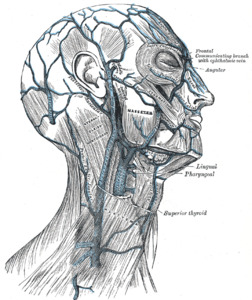
Briefly, when it comes to the scalp, it has five layers: (1) skin; (2) dense connective tissue (it contains blood vessels); (3) epicranial aponeurosis; (4) the loose areolar connective tissue (it separates the percosteum of the skull from the epicranial aponeurosis; and (5) the periosteum (the outer layer of the skull bones. It becomes continuous with the endosteum at the suture lines). And the blook travels from the scalp. Here is how:
“The blood from the scalp travels through a complex network of arteries and veins. The superficial temporal artery is a key artery that supplies blood to the scalp and face. It branches off from the external carotid artery and has multiple branches that take blood to the forehead’s muscles and skin. The superficial temporal veins drain blood from the scalp and face, with the angular vein being a terminal branch that drains blood from the scalp to the neck.
“The internal jugular veins are responsible for draining deoxygenated blood from the skull and brain, and the jugular veins return deoxygenated blood to the heart. The dural venous sinuses collect blood from the brain and transport it to the internal jugular veins, which then drain into the subclavian veins and the external jugular veins. The supraorbital and supratrochlear veins drain blood from the forehead and the angle of the mouth, respectively. These veins and arteries work together to ensure efficient blood return from the scalp and face to the heart.”
Note: From the nose to the scalp the toxin(s) travel throughout the body system to the heart.m INHALED TOXINS ARE A DANGER TO ONE’S WELL-BEING.
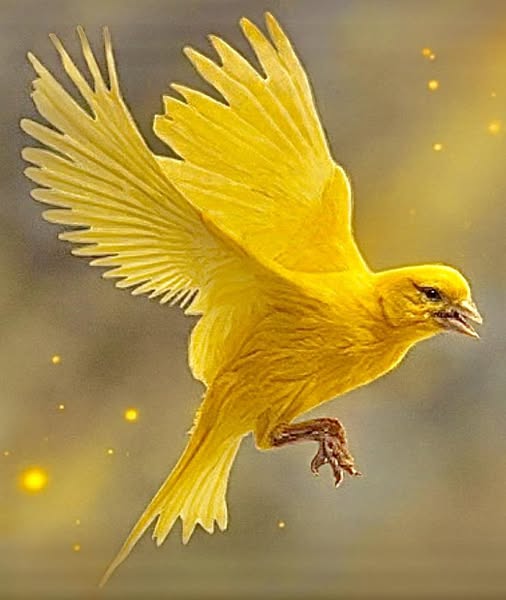
In recent times, one hears political talking heads and some journalists use the term “the canary in the old mine” for other than its original meaning: taking little canaries down into the mines to let them slowly die of carbon monoxide poisoning. Sad, very sad. Yet, we persist in using toxic chemicals to supposedly make us live better, normalizing toxicity in our every day lives. Now this is very damn tragic to say the least when other countries have banned chlorpyrifos from its multiple uses. And yet the unenlightened Trump Administration recently had the U.S. Environmental Agency remove the ban under the Biden Administration.
A FULL DISCLOSURE So that we may know how serious this chemical agent is, AI Perplexity and AI ChatGPT responses have been reprinted below.
Chlorpyrifos is an organophosphate insecticide whose main health risk is neurotoxicity—it inhibits acetylcholinesterase, causing overstimulation of the nervous system, with particular concern for fetuses and children.
• Runny nose, tearing, excessive salivation and sweating
• Nausea, vomiting, abdominal cramps, diarrhea
• Blurred or darkened vision, muscle twitching, tremors, weakness, loss of coordination
At high doses or severe poisoning, reported effects include==
• Loss of bladder and bowel control, seizures, unconsciousness or coma
• Respiratory muscle paralysis, respiratory failure, and death
• Severe organophosphate poisoning syndromes with convulsions and profound weakness
Chronic and developmental effects:
Evidence from human cohort and animal studies points to significant longer‑term risks, especially with prenatal or early‑life exposure:
• Developmental delays and neurodevelopmental disorders in children
• Reduced IQ and working memory, attention problems, ADHD‑type symptoms
• Changes in social behavior and brain development in animal studies, with young animals more sensitive than adults
Occupational and repeated exposures have also been associated with–
• Peripheral neuropathy (numbness, “pins and needles,” weakness, poor coordination)
• Possible liver damage
• Epidemiologic signals for Parkinson’s disease with chronic exposure (for chlorpyrifos and related pesticides)
Reproductive, endocrine, and cancer concerns of additional possible risks, although not all are fully resolved–
• Endocrine disruption: hormone level changes and sex‑specific behavioral effects in animal models
• Greater sensitivity in pregnant women and the fetus
• Emerging data suggesting possible links to lung and prostate cancer, even though EPA’s cancer classification has historically been “evidence of non‑carcinogenicity”
Who is most at risk?
Groups with higher potential exposure and vulnerability include–
• Farmworkers, pesticide applicators, and workers in chlorpyrifos manufacture or formulation
• Pregnant women and their fetuses in agricultural regions
• Children living near treated fields or in housing where it was historically used
International Bans and Restrictions
European Union
The EU has banned chlorpyrifos and chlorpyrifos-methyl entirely from use in plant protection products since 2020.
United Kingdom
The UK banned chlorpyrifos (with limited exceptions) as of April 2016.
Canada
Canada cancelled all chlorpyrifos uses and products, effectively banning it.
New Zealand
New Zealand’s Environmental Protection Authority announced plans to ban chlorpyrifos completely, with phase-out timelines in 2025–2026.
Thailand
Chlorpyrifos was banned under Thai law effective June 1, 2020.
Nepal
Nepal implemented an immediate nationwide ban on chlorpyrifos (alongside other hazardous pesticides) in late 2024.
🌎 Other National Bans
Reports and regulatory documents indicate chlorpyrifos has also been banned in several other countries, including:
Argentina, Morocco, Sri Lanka, Indonesia, Switzerland, Saudi Arabia, Palestine, Trinidad & Tobago, Turkey and South Africa for various uses.
Various sources list additional bans or non-approvals in countries like Sweden, Egypt, Vietnam, and India (with some restrictions and exemptions depending on the use).
🌐 Global Phase-out Effort
In 2025, parties to the Stockholm Convention on Persistent Organic Pollutants agreed to phase out chlorpyrifos globally with specific exemptions — a move toward eliminating nearly all uses worldwide.
Summary
Banned: EU, UK, Canada, New Zealand (phase-out), Thailand, Nepal, and many others.
Restricted or phased out: Some regions (e.g., specific crop uses or states within countries).
Global effort: Stockholm Convention aims to eliminate it globally, though exemptions remain.
Chlorpyrifos has been used far beyond just crop spraying. Here are the main categories of use historically:
1. Agricultural Uses (Most Common)
Corn
Soybeans
Fruit trees (apples, oranges)
Tree nuts (almonds, walnuts)
Broccoli, cauliflower
Cotton
Wheat
It’s a broad-spectrum organophosphate insecticide, meaning it kills many types of insects by disrupting their nervous systems.
2. Residential / Structural Pest Control (Largely phased out in many countries)
Termite treatments
Cockroach control
Ant control
Flea treatments (yards, kennels)
In the U.S., most residential uses were canceled in the early 2000s because of child exposure risks.
3. Public Health Uses
Mosquito control in some regions
Control of flies in public spaces or livestock areas
Some countries have restricted these uses, but they still exist in limited areas globally.
4. Livestock Applications
Treatment for ticks, lice, and mites on cattle and sheep
Barn and stable insect control
5. Non-Food / Industrial Uses
Turf management (golf courses, athletic fields)
Utility pole and fence post treatments (wood protection)
Greenhouse insect control
Important Reality – Chlorpyrifos is potent! So, who manufactures chlorpyrifos?
The reason many countries are banning it isn’t because it’s ineffective — it’s because it’s potent. Chlorpyrifos affects acetylcholinesterase, an enzyme critical for nervous system function. The same mechanism that kills insects can harm human neurological development, especially in children.
Chlorpyrifos has been manufactured by several agrochemical companies over the years. The main ones include the following:
Major Manufacturers (Historically and Currently)
Dow Chemical Company Originally developed chlorpyrifos in the 1960s. It was sold under the brand name Lorsban.
Corteva Agriscience Spun off from DowDuPont in 2019 and inherited chlorpyrifos products. Corteva announced it would phase out production in 2020.
Makhteshim Agan (now part of ADAMA Agricultural Solutions) Produced generic chlorpyrifos formulations.
Nufarm Manufactured and distributed chlorpyrifos products in multiple markets.
Gharda Chemicals A significant producer of chlorpyrifos for export markets.
Several Chinese manufacturers, including large state-linked agrochemical firms, have also produced chlorpyrifos for global export markets.
Important context:
Many Western companies have exited production due to regulatory pressure and liability concerns. However, production continues in parts of Asia and other regions where regulations remain less restrictive.
From an investment standpoint, chlorpyrifos itself is not generally considered a growth chemical in traditional portfolios — largely because of regulatory pressure, bans in major markets, and shifting industry dynamics. Here’s how to view it if you’re thinking about capital allocation OR if you do not care about the health and well-being of the global citizenry:
1. Declining Demand in Developed Markets
Regulatory authorities in the United States and European Union have restricted or revoked many uses of chlorpyrifos due to health and environmental concerns, significantly reducing its market footprint in those large agricultural economies.
Many companies have reduced or stopped production, such as Corteva Agriscience exiting chlorpyrifos production and shifting to safer alternatives.
Investment implication: legacy products like chlorpyrifos are not growth engines in developed markets and carry regulatory and legal risk.
2. Regional Opportunities Still Exist
While bans are tightening in Western markets, demand persists in parts of Asia, Latin America, and Africa where regulatory constraints are less strict and large-scale agriculture still uses broad-spectrum pesticides.
Some producers are innovating safer or low-residue formulations to remain compliant and extend product life in certain markets.
Investment implication: niche exposure in emerging markets may still generate revenue, but this tends to be more speculative and dependent on regulatory trends.
3. Regulatory Risk and Litigation
Because chlorpyrifos has been linked to neurological effects — especially in children — companies tied to its production face litigation risk, reputational risk, and potential future bans even where currently permitted.
Environmental, social, and governance (ESG) investing trends penalize exposure to hazardous chemicals, pushing capital away from products with poor health or sustainability profiles.
Investment implication: direct investment in chlorpyrifos production companies carries higher long-term risk.
4. Broader Agrochemical Industry Context
Rather than investing in chlorpyrifos itself, many analysts position investment more favorably in broader or adjacent sectors:
✅ Biopesticides and Sustainable Inputs
Consumer and regulatory shifts toward safer, low-impact pest control are creating growth opportunities. Biopesticides and next-generation crop protection products are gaining traction.
✅ Integrated Pest Management & Precision Ag Tech
Technologies that reduce reliance on traditional pesticides — such as precision spraying and biological controls — are attracting institutional interest.
📌 Example investment angles
Agrochemical companies diversifying into biologicals or safer chemistries
Precision farming and ag-tech platforms improving application efficiency
Sustainable agriculture ETFs or funds focused on ESG compliance
🧠 Bottom Line
Chlorpyrifos itself is generally not a growth investment.
Its traditional market is shrinking due to regulatory bans and health concerns.
Significant regulatory and ESG risks make it unattractive as a standalone investment.
Potential value is more likely found in companies pivoting toward safer pest control solutions or broader agricultural technology.
With all this known reality about this pesticide, why does the Trump Administration still persist in not regulating it, including other toxic agents under President Trump's first and second terms?
Bonus
For ingredients in producing chlorpyrifos, navigate HERE. Additional: Febreze ingredients, the most highly marketed toxicity.
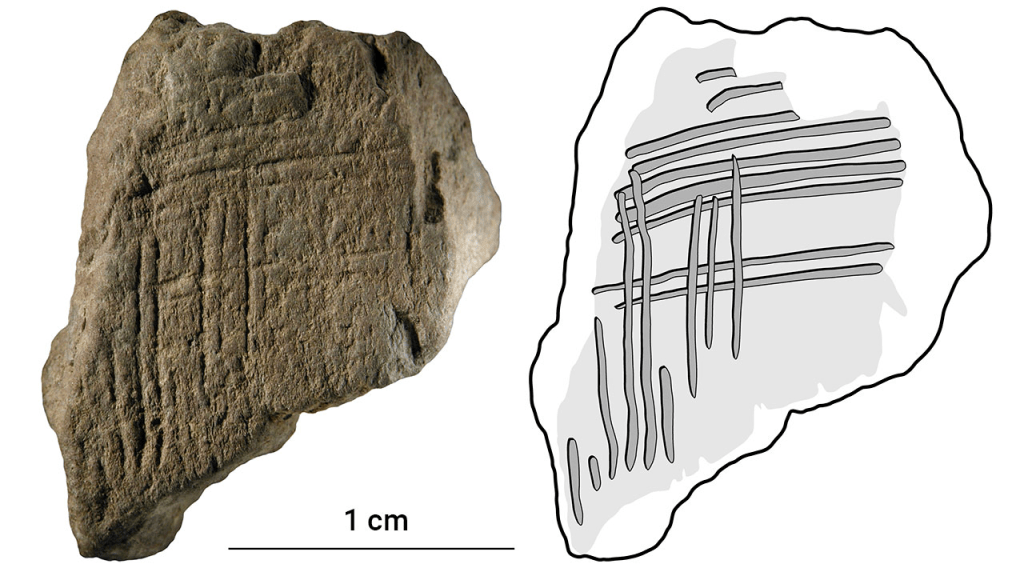
An early human scratched this hashtag pattern into a red ochre stone at Blombos Cave in South Africa. It is estimated to be about 100,000 years old. Source: Science.org
Can you imagine the first symbol a hominid made about 100,000 years ago? It appears to have been a hashtag? What could it have been like for him or her to make the first downward line on a hard surface? It was generated more than likely by a thought that then became a symbol. Maybe it was to say, “This is one, this one is two,” ad infinitum. The curve, then the circle, followed by a spiral? In each case, each marking was a symbol to generate a mark.
So, what is symbol? A mark, sign, or word that represents an idea, object, color, relationship, or answer. Symbols as allegories are interesting. Every plot element in an allegory represents something in the story. For example, in Plato’s “Allegory of the Cave,” everything in the cave is an allegory—from the cave to the people, fire, shadows, and chains. Plato explained the allegory by saying that “Those who are able to see beyond the shadows and lies of their culture will never be understood, let alone believed by the masses.” He speaks to the ignorance of humanity trapped in the conventional ethics formed by society.
In Buddhism, the cave is a metaphor used to illustrate the illusory nature of the material world. The cave represents the human condition where individuals are trapped in a limited perception of reality. The shadows cast on the cave wall represent the material world, which is a reflection of deeper truths that can only be understood through philosophical inquiry and enlightenment.
Albeit related to symbolism, a metaphor compares two seemingly unrelated things, stating that one thing is another. In the Armida Trilogy, there are several such metaphors; however, the three novels are laden with symbolism. In fact, each chapter of two of the books is introduced with a symbol. And, Book II offers a chart of the symbols as used in Choir of Cloistered Canaries.
In the first chapter of Daughters of the Dance, long hair becomes a symbol of the first character—her long hair is likened to her headdress. It was, in biblical times, a way of identifying an individual’s social status and cultural identity. For women in biblical times, long hair was associated with femininity, beauty, modesty, and submission to a higher authority (both the husband and God).
In Choir of Cloistered Canaries, water as a healing element is present to symbolize life and vitality, purity and renewal, emotional depth, spiritual significance, and cultural importance. In case we forget, the average percentage of water in the human body is roughly 60%. The percentage range of water varies slightly, usually within a 50 to 75 percent range. Water, moreover, has many uses in chemical processes as a working fluid to convert heat energy to mechanical energy. There is historical reference as to how a historical woman, Maria Hebraea (c. 300 C.E.) who invented several kinds of chemical apparatus such as the bain-marie. She made distillation a new invention. Carl Jung used Maria’s axiom—“One becomes two, two becomes three, and out of the third comes s the one as the fourth”—as a metaphor for wholeness and individuation. Afterall, Maria was known for her alchemy, the first known Western alchemist.
There is another analogy to Choir of Cloistered Canaries that is embedded in the title: “Cloistered,” synonymous with “caged.” In Buddhism, the cage refers to the idea that the mind and body are like a bird in a cage. The bird sees that it is not able to fly freely, thus the metaphor illustrates a sense of disenchantment and the desire for liberation from suffering. Unlike our current environment where we have to put up and shut up, it becomes difficult to recognize that there is a way out of the cage. Book Three addresses this conundrum or challenge.
The third book, Even a Crow Knows How to Crack a Walnut in Clear Light, uses the Star of David to highlight the lost memory of two acute angle triangles, one inverted over the other (the Mazzorath). It reflects an origin from the Vedic and Upanishadic India around the first half of the first millennium B.C.E. In early Indian thought, the two halves (or acute angle triangles described the primordial Self split into two parts (male and female). Later, the Yin-Yang concepts in Taoism came about as early as the 14th-13th century B.C.E. The Yin represents moon energy associated with reflection, inner awareness, and sensitivity; the Yang represents the sun energy associated with activity, dynamism, and vitality. This lays the foundation of Ana and her mother to find agency in a world still governed by male conventions in the 21st century. Thus, the Armida Trilogy reflects the struggle of women as the setting and finally a resolution to the challenge of being human and feminine.
As a mental exercise on current events, how would you view what the following gallery of images portrays? What do they symbolize?
Did you know that the term “Nazi” (short for “Nationalsozialist”) was considered derisory even when the Nazi Party grew out of smaller political groups with a nationalist orientation that formed in the last years of World War I? Truly, and the three novels of the Armida Trilogy did not shy away from making reference to their existence. Their ideology represents, historically, racist ideology and devastation.
The undertaking sprung as early as 1918 as a league called the Freier Arbeiterausschuss für einen guten Frieden (“Free Workers’ Committee for a good Peace”). It was definitely a populist movement that formed when Germany was in great turmoil after four years of World War I. It was an opportunistic event during the period of the German Revolution (1918-1919). The aftermath of this short revolution was followed by a period of instability and violence. The aforementioned league coalesced by 1919 as the Nazi Party, known as the German Workers’ Party and soon thereafter was led by spellbinding Adolf Hitler from 1939 to 1945, using totalitarian methods with an ideology that led to the state-sponsored and systematic murder of up to 17 million Europeans (mostly the “undesirable” Jews, Roma, and Sinti (Slavic) people).
Of those murdered, the Jewish people were in the majority; and there were at least twelve known locations of extermination at which the notable ones were at the German-occupied Soviet Union (1,300,000), Auschwitz (100,000,000), Treblinka (925,000), and Jewish ghettos (800,000). [Statista.com, 2025.] There were many other people who did not get counted, but it is estimated that, during the war, millions of people deemed to be of lesser import were captured and used as slave laborers. Exploited, a large number died of exhaustion, individual execution, and starvation. A majority of these deaths were recognized as systemic “crimes against humanity.” How does this become possible in any era of history?
The film “Nurenburg” (2025) has recently been released and was based on journalist-historical writer Jack El-Hal’s book The Nazi and the Psychiatrist: Herman Gȫring, Dr. Douglas M. Kelley, and a Fatal Meeting of Minds at the End of WWII. Basically, the book follows Dr. Kelley’s evaluation of top Nazi leaders to determine if they were mentally fit to stand trial and to understand the alluring “Nazi mind” or possible pathological defects to explain their crimes. In summation, the doctor determined that the Nazi mind was distinctly developed to include blind ambition, weak ethical morals, and extreme nationalism. Kelley, nonetheless, during his interviews, was intellectually and psychologically drawn to the outlooks of these 22 charismatic Nazi leaders. What disturbed the doctor mostly was their sense of evil without obvious madness. Though he did not convert to Nazi beliefs, he concluded they were largely sane with a permissive, radicalized political system to uphold their belief system of a master race as Aryans.
(However, it is not hermetically certain that Dr. Kelley died by suicide by ingesting a capsule of potassium cyanide in front of his family or if he was mysteriously murdered by Nazi hunters. Suggestive but not conclusive especially no one who loves life would admit to have been threatened to admit a different story. We know how conspiracy theories work. Take this with a grain of salt.
(Nein, nein, nein. Bitte, passen Sie auf. Dr. Kelley did have a tragic death. The aforementioned paragraph is just an imaginary episode for the Netflix series, The Hunters, in portraying the aftermath of the ghost of Dr. Kelley in mentally experiencing the trauma of his tribe during WW II. Imagining to avenge in the face of evil is never sweet.)
At any rate, of all the top Nazi leaders, it was Heinrich Himmler who founded the SS Ahnenrbe (“Ancestral Heritage”) to trace and to reconstruct an ancient Aryan past. In fact, during sponsored expeditions to Tibet, he brought back the practice of mindfulness training, which was required of every SS officer to master. That is one reason SS officers in films are portrayed as removed from any emotional expression. When that failed, his Ahnenerbe teams focused on evidence of prehistoric Nordic-Aryan dominance. Nonetheless, it was Hitler’s beliefs that Germans were the modern descendants of “the superior ancient Aryans of the “Bronze Age” (“Eastern Europe”) and later of Nordic race as the “best” racial stock destined to rule. Afterall, there was Thor, a hammer-wielding god associated with thunder, storms, strength, protection, fertility, farmers, and free people. And then there is the Vedic Indra, the king of the devas and svarga, associated with thunder, lightning, weather, god of order who killed the great evil. Nazi archeology was used to justify and to frame invasions into Eastern Europe, for example, using political, strategic, and economic goals first.
There was never a human race as claimed by the Nazis. Modern Nazis don’t like to be referred to as Nazi; at best, they see themselves as a White Race. However, there is a reason why Caucasian was used as a race albeit an obsolete racial classification of humans with a biological taxonomic group that usually included ancient and modern populations from all or parts of Europe, Western Asia, Central Asia, South Asia, North Africa, and the Horn of Africa. The United States still uses the term to be synonymous for people considered “white” (thus perpetuating bigotry and racism) or of European, Middle Eastern, or North African ancestry. Nevertheless, biological diversity has advanced during the second half of the 20th century, which is based on genomic and population-based perspective of humans based on phenotype, ancestry, and cultural factors.
The original meaning of the term “Aryan” is mostly cultural or religious and means “civilized” or “noble”. Shakyamuni Gautama used the term “noble” to define his “noble truths.” In ancient times, “truth” was a means to understand life and existence through experience and observation (similar to the Buddha’s (“Charter of Inquiry” in italics below). The search for truth was not intended to be a belief system, because a belief system tends to truncate the search for truth. The latter refrains from consider new, valid information.
Charter of Inquiry – Buddha Shakyamuni’s Other Legacy, This Charter of Inquiry, provided by the Buddha Shakyamuni, is a guideline for thoughtful people on what they need to be aware of when exploring religious and spiritual values and beliefs. When Buddha Shakyamuni was asked by the Kalama people, “How do we know who is telling us the truth?”, he replied the following:
Do not accept anything because of–
1/ repeating oral transmission 2/ lineage or tradition 3/ it being written in books such as scriptures 4/ it being widely stated 5/ it being logical and reasonable 6/ it inferring and drawing conclusions 7/ it having been thought out 8/ acceptance and conviction through thinking about a theory 9/ the speaker appears consistent 10/ respect for the teacher.
He further added, “Know what things would be censured by the wise and which, if pursued, would lead to harm and suffering.”
MIDDLE BRONZE AGE
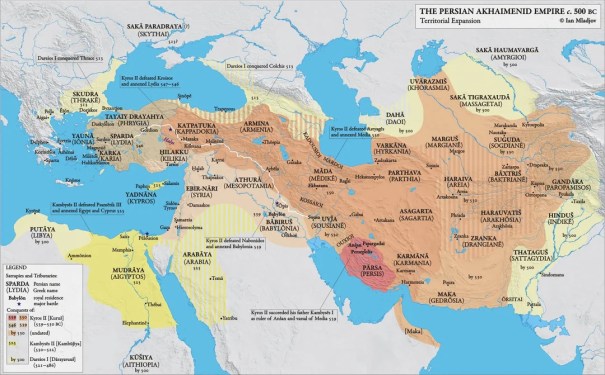
Map of the Aryan Persians Acahemenid Empire
Reaching back to the Bronze Age, a group of people emerged speaking an Indo-Iranian language in ancient Iran and in the northern Indian subcontinent. Indo-Aryan people (aka Indic or Vedic peoples) were a diverse collection of people who migrated from Central Asia into the northern Indian subcontinent, mainly residing west of the Indus River and later spreading eastwardly (modern-day Bangladesh, Bhutan, Nida, Nepal, Pakistan, and Sri Lanka. Another band of Indo-Aryan people migrated further westward and founded the Mitanni kingdom in northern Syria around 1500-1300 BCE. Evidence shows they were connected culturally, linguistically, and historically. Historically, the Aryans were the pastoralists who migrated from Central Asia and eventually horsemen, charioteers, and known as Scythians. Much of their migration was due to the emergence of climatic change that became colder and drier.
They shared cultural norms and language as they began to refer to themselves as arya (“noble”). The Indo-Aryans were united by shared cultural norms and language, referred to as aryā ‘noble’. Over four millennia, the culture evolved particularly inside India itself and eventually conflated with other values and heritages. We have the remnants of hymnal Gathas, Avesta and Rig Veda literature to attest to these Zoroastrian and Vedic heritages, despite genetic variances. The similar languages of the Zoroastrian Avesta and the Vedic Rig Veda, but not identical, indicate that these people were related and neighbors. The Avesta and Rig Veda scriptures are the only known ancient texts that contain references to Aryans, with the Avesta containing a preponderance of references to being Aryan, a concept central to the Avesta and Zoroastrian heritage.
As mentioned earlier, when the Shakyamuni Siddhartha Gautama spoke of the Noble Eightfold Path that is called arya maga in Sanskrit or ariya magga. When he taught the eight Noble Truths, he was indicating that they chose to advance spiritually—the noble ones, the spiritual elite, who obtain this status not from birth, social station, or ecclesiastical authority but from their inward nobility of character—by right view, right intention, right speech, right action, right livelihood. Right effort, right mindfulness, and right concentration. He recognized that the Brahmin Vedic system was self-righteous and instilled suffering to control the masses. His Noble truth is summed up like this: The truth (arya) about suffering; the truth on what causes suffering; the truth that suffering can cease in this lifetime; and the truth on how to cause suffering to cease.
Modern scholarship dates the founder of Zoroastrianism, Zarathushtra (aka Zoroaster), between 1500 and 1000 BCE and believed to been born in various parts of “Greater Iran.” However, it is likely that he came from Bactria or Chorasmia, regions that incorporate the Amu Darya (aka Oxus) river delta in western Central Asia, bordered on the north by the Aral Sea. (This was Saka territories under Darius I.) The land was fertile and known for its cavalry and role as a cultural crossroads, often linked with the “Aryan” people who migrated there, forming powerful kingdoms (similar to the legendary one in the Avesta), which formed a warrior aristocracy known for loyalty and fierce spirit.
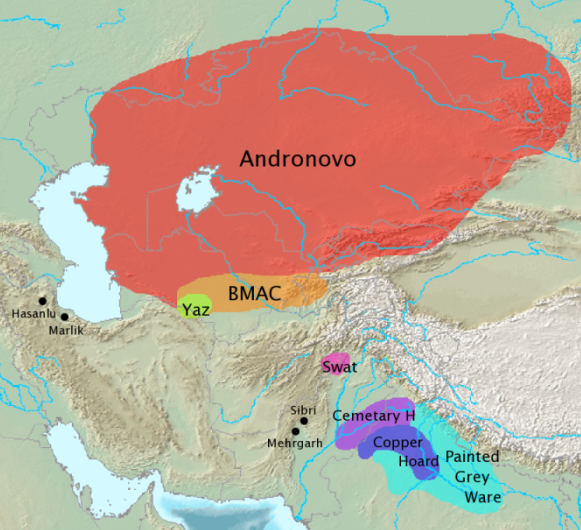
In summary, current anthropological-archeological migration is as follows: “The Proto-Indo-Aryan split off around 1800–1600 BCE from the Iranians, moved south through the Bactria-Margiana Culture, south of the Andronovo culture, borrowing some of their distinctive religious beliefs and practices from the BMAC, and then migrated further south into the Levant and north-western India. The migration of the Indo-Aryans was part of the larger diffusion of Indo-European languages from the Proto-Indo-European homeland at the Pontic–Caspian steppe which started in the 4th millennium BCE. The GGC, Cemetery H, Copper Hoard, OCP, and PGW cultures are candidates for cultures associated with Indo-Aryans.”
It bears repeating: The Aryan Race was never a race. Stay tuned, for there is still missing knowledge of how migrations influenced history by various commonalities. In fact, if racism were to be eradicated, there would only be one Homo sapiens sapiens of modern humans.
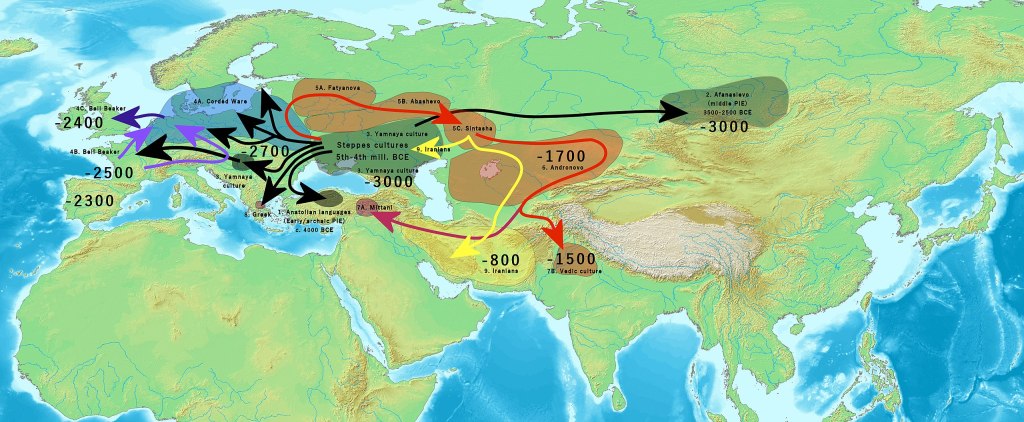
The Indo-Iranian Migration
Scheme of Indo-European language dispersals from c. 4000 to 1000 BCE according to the widely held Kurgan hypothesis.
Anonymous recently said, "Beware. The White monsters walk the streets in the United States of America."
Imagine a protagonist named Armida inspired 18 operas entitled “Armida” and their composers, ranging from the 17th to the 21st centuries. Most operas focus on the character of said name while others focus on her relationship with the Crusader knight named Rinaldo. There was even a film and a ballet, not to mention many paintings.
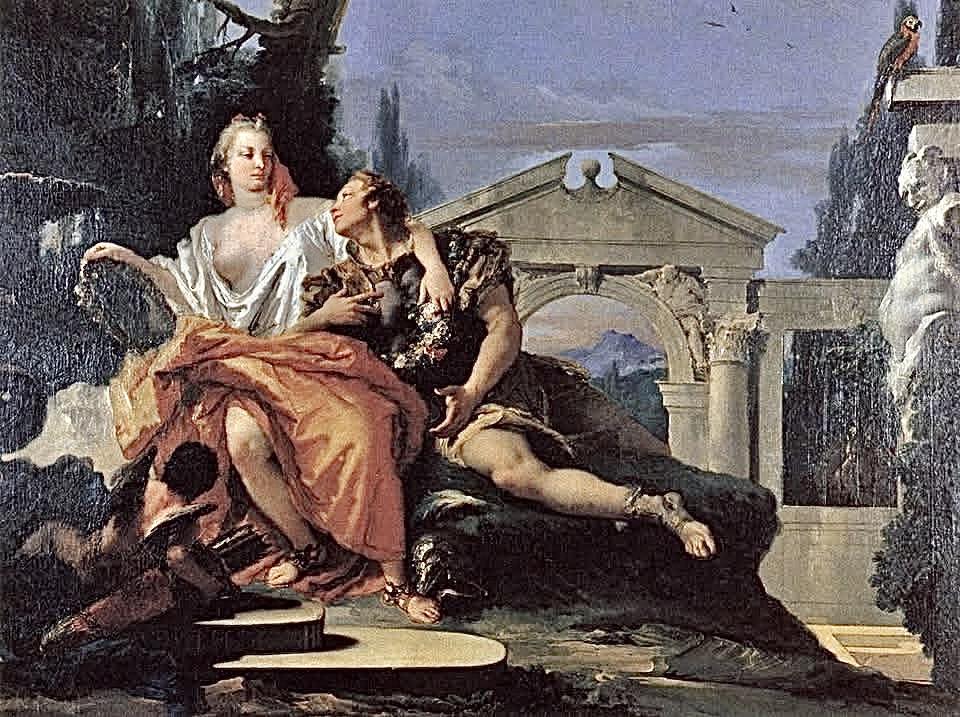
Painting, Rinaldo and Armida by Tiepolo (1755)
There are a few narrative origins in Tasso’s epic poem, and they are the following:
Armida is a Saracen enchantress modeled after mythic figures–Circe from Homer’s The Odyssey and Alcina in Ludovico Aristo’s Orlando Furiosa (The Frenzy of Orlando). The latter was based on an unfinished chivalric romance (Orlando innamorato) by Matteo Maria Bolardo and was published posthumously in 1495, which exerted wide influence in northern Italian culture.
Homer’s enigmatic Circe represents the duality of feminine power and the boundary between civilization and wilderness, blending danger and hospitality as well as seduction and wisdom. As for Aristo’s Alcina, she is the pagan princess who is loved by Orlando, a Christian knight. His unrequited love drives him mad and forgets his original purpose to fight the Saracen army that was invading Europe to overthrow Charlemagne’s Holy Roman empire.
In Tasso’s epic poem, Armida is a Saracen enchantress. Sent to disrupt the Christian crusaders, she infiltrates their camp with seductive magic, turning the knights against each other and even transforming some into animals. Rinaldo, the greatest knight, is abducted by Armida when she finds him sleeping and is smitten instead of slaughtering him. She whisks him away to a magical isle where Rinaldo is bewitched by Armida, forgetting his duties as a crusader against the infidels.
When Rinaldo recognizes his enchanted state with the help of his companions, Carlo and Ubaldo, he is drawn back to the fight.
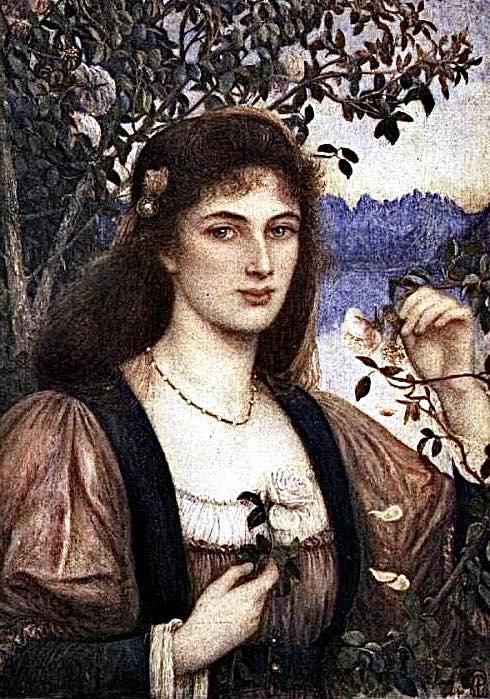
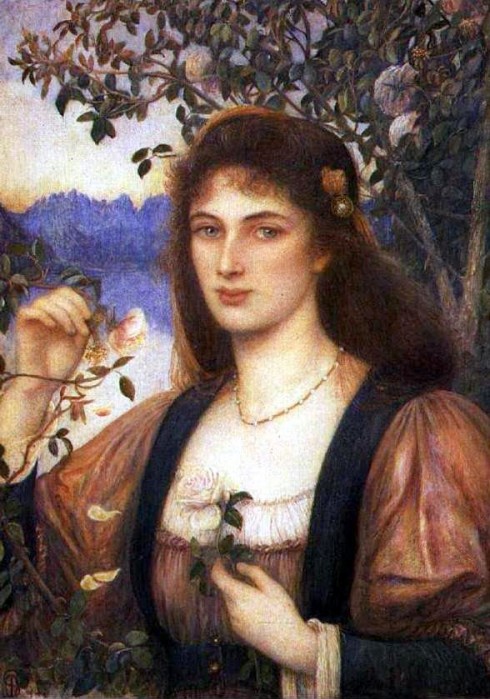
Painting: The Rose from Armida’s Garden by Marie Spartali Stillman (1894).
She is often depicted in a lush garden.
Devastated by his departure, Armida raises an army to battle the Christian crusaders and to seek vengeance. Once defeated, she attempts suicide but is rescued by Rinaldo who asks her to convert to Christianity. Once she recanted, however, she is burned at the stake as a witch.
In other renditions, Armida is abandoned.
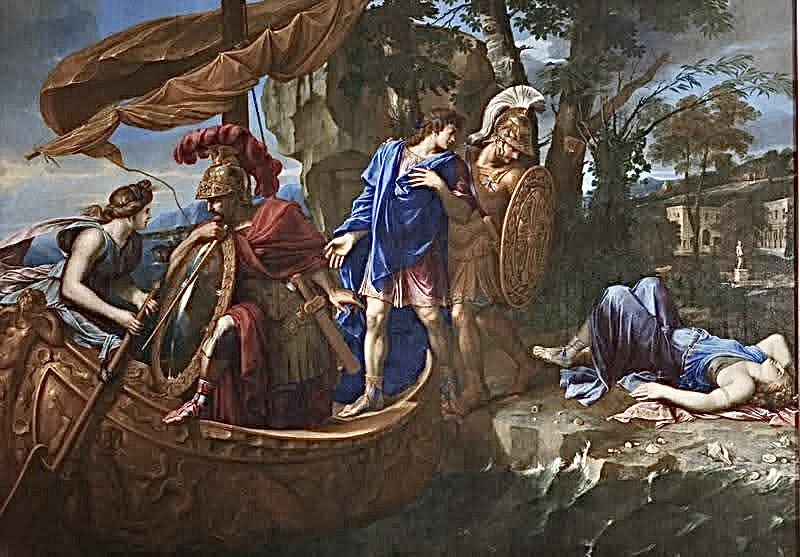
Painting, Renaud abandonnant Armide, Charles Errard (17th century)
These are some of the known composers of various operas Armida and/or Rinaldo:
Claudio Monteverdi (1627), Jean-Baptiste Lully (1686), John Dennis (1698), George Frideric Handel (1711), Antonio Vivaldi (1718), Tommaso Traetta (1761), Niccolo Jommelli (1770), Antonio Salieri (1771), Antonio Sacchini (1772, 1773), Christoph Willibald von Gluck, (1777), Josef Mysllivecek (1780), Joseph Haydn (1783), Giuseppe Sarti (1786), Francesco Bianchi (1802), Gioachino Rossini (1817), Antonin Dvorak (1908), and Judith Weir (2005).
There are three ballets–Armida, Le Paillion d’ Armide, and Rinaldo and Armida; and there is a 10-minute segment in the anthology film Aria that is loosely based on a version of Armide.
The operas named Armida or related to her character were black listed by the Roman Catholic Church in what was vernacularly referred to as the Black List. Officially known as the Index Librorem Prohibitorium, it listed banned books deemed heretical or contrary to Catholic morality since 1559. It was updated annually until Pope Paul VI abolished the end of its enforcement in 1966. Until then, many Armida works were banned!
Last but not least, the name Armida has several claims as to origin. “Little Armed One” is a more current meaning in Italian and in Spanish. However, according to the Wisdom Library, the name has an Old High German origin–Irmhild (Irm means something like “universal” and hild means “battle”). Moreover, the name is associated with the Arabic word “Armid to mean “strong-willed.” As “Ermin,” Armida symbolizes wholeness, completeness, and universality.
Notwithstanding the above paragraph, there is a shared etymology to the terms “army” (English), “armada” (Spanish/Portuguese), “armata” (Medieval Latin), and “armée” (French). They are derived from ar(e) or h2er, a Proto-Indo-European root that means “to fit together” as in arming or equipping for service or battle. Strangely enough, the Italian word for army is “esercito”. The Latin arma, to mean weapon, appears throughout the Romance family of languages. In Celtic languages, it cognates as arf or arm. In Ancient Greek, it is harmos (fitting together); in Sanskrit, it is irma; in Old Armenian, it is armukn.
Attestation of arma appears in Early Latin inscriptions of the 6th century BCE. In Ancient Greek, harmos appears in Homeric and classic texts. And, in Sanskrit, irma appears in Vedic and classical Sanskrit, relating to the meaning of “limb” and “fitted part” and somewhat like Sanskrit ayudha, which in Spanish translates as “help” or “aid”. All this leads to the conclusion, linguistically and culturally, that these terms evolved somewhat independently in accord with regional religious, military, and cultural priorities but retained a core concept of fitting, arming, aiding, and weaponry.
But, we still have no idea why Tasso used the name Armida; and yet, it is a befitting name for a she warrior.
Overall, the name embodies themes of strength, femininity, independence, empowerment, and allure, even power is softness, making it a captivating name in various cultures.
A retiring CDC epidemiologist reunites with her estranged mother and is swept from a secretive lab in North Carolina to Rome, where science, mythology, and a surprising papal alliance ignite a transnational fight for environmental justice and moral stewardship.
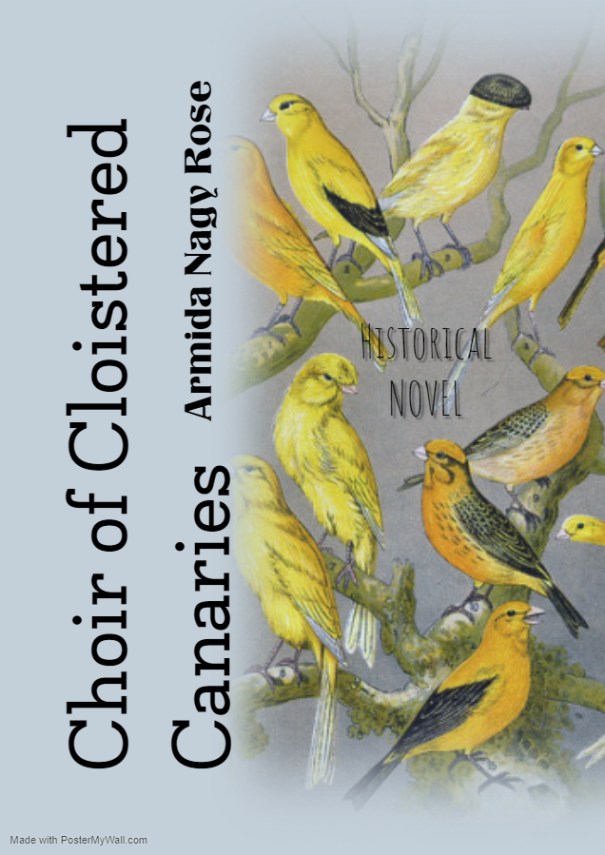
Choir of Cloistered Canaries – Book Two (2020) is a thought-provoking, multi-layered novel that fuses epidemiology and psychology with ancient symbolism, environmental activism, and mystical exploration – wrapped in an emotionally-grounded take of reconnection, love, and resistance against ethical erosion. It uses the canary as metaphor to champion environmental guardianship and justice for all.
Anyone who is interested environmental justice when science meets spirituality would be attracted to the environmental appeal and intellectual adventure.
Leitis Dennett, a senior CDC epidemiologist about to retire, is called to a secretive laboratory at the North Carolina Research Campus to reconnect with her estranged mother of several decades. As a member of the CDC Rapid Response Team, her visit to her mother is cut short to join the team headed for The Vatican and Rome, Italy. It is there that a fortuitous relationship with Pope Hormisdas II develops.
It is also at this journey that she meets a medical engineer who joins her to further improvements on public health and to combat environmental degradation, echoing President Eisenhower’s warning in 1961 against unchecked industrialization and over consumption.
The novel resonates with modern concerns—clean air, water, and earth—representing “our song as canaries,” a metaphor for how human signal ecological distress. Leitis blends her epidemiology expertise with her passion for comparative mythology and alchemy, searching for hidden meanings in ancient symbols.
Beyond global stakes and politics, the novel is deeply personal—a mother and daughter healing almost a half-century of separation.
If you are drawn to environmental activism, ethical science, and storytelling where ancient wisdom meets modern dilemmas, this novel delivers. Even as a human story, it is framed within larger questions of mortality and stewardship.
In summary, Choir of Cloistered Canaries blends a personal mother-daughter reunion with a global quest to expose and counteract corporate greed, sacred symbolism, and environmental collapse. It asks readers to listen to the Earth’s “canary” warnings.
There are four principal characters worth mentioning:












 Armida Nagy Rose Author