
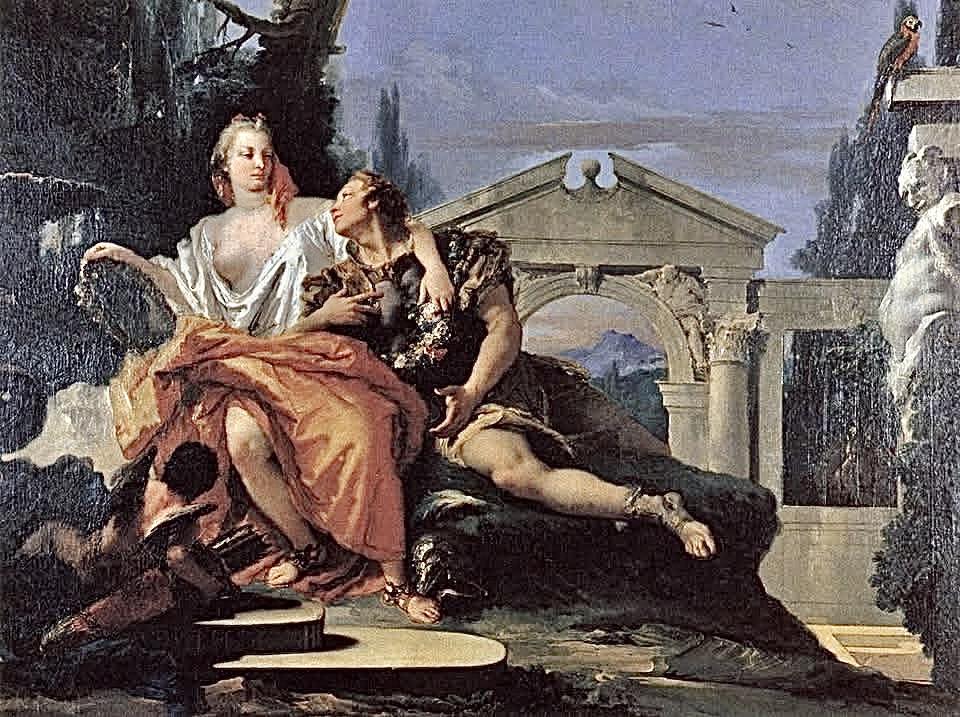
Imagine a protagonist named Armida inspired 18 operas entitled “Armida” and their composers, ranging from the 17th to the 21st centuries. Most operas focus on the character of said name while others focus on her relationship with the Crusader knight named Rinaldo. There was even a film and a ballet, not to mention many paintings.
Painting, Rinaldo and Armida by Tiepolo (1755)
There are a few narrative origins in Tasso’s epic poem, and they are the following:
Armida is a Saracen enchantress modeled after mythic figures–Circe from Homer’s The Odyssey and Alcina in Ludovico Aristo’s Orlando Furiosa (The Frenzy of Orlando). The latter was based on an unfinished chivalric romance (Orlando innamorato) by Matteo Maria Bolardo and was published posthumously in 1495, which exerted wide influence in northern Italian culture.
Homer’s enigmatic Circe represents the duality of feminine power and the boundary between civilization and wilderness, blending danger and hospitality as well as seduction and wisdom. As for Aristo’s Alcina, she is the pagan princess who is loved by Orlando, a Christian knight. His unrequited love drives him mad and forgets his original purpose to fight the Saracen army that was invading Europe to overthrow Charlemagne’s Holy Roman empire.
In Tasso’s epic poem, Armida is a Saracen enchantress. Sent to disrupt the Christian crusaders, she infiltrates their camp with seductive magic, turning the knights against each other and even transforming some into animals. Rinaldo, the greatest knight, is abducted by Armida when she finds him sleeping and is smitten instead of slaughtering him. She whisks him away to a magical isle where Rinaldo is bewitched by Armida, forgetting his duties as a crusader against the infidels.
When Rinaldo recognizes his enchanted state with the help of his companions, Carlo and Ubaldo, he is drawn back to the fight.
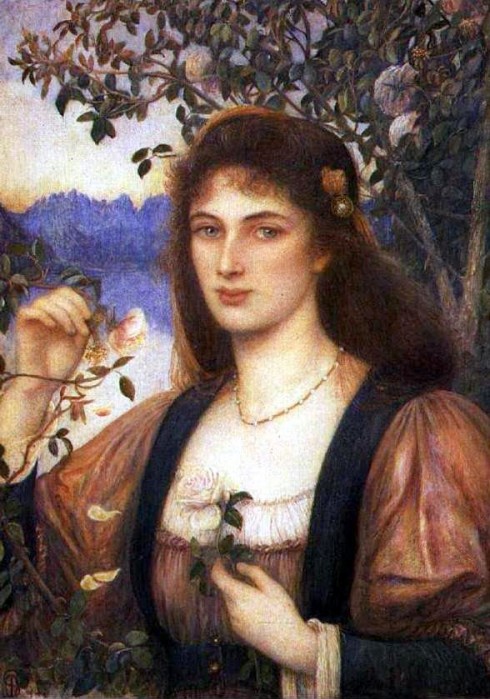
Painting: The Rose from Armida’s Garden by Marie Spartali Stillman (1894).
She is often depicted in a lush garden.
Devastated by his departure, Armida raises an army to battle the Christian crusaders and to seek vengeance. Once defeated, she attempts suicide but is rescued by Rinaldo who asks her to convert to Christianity. Once she recanted, however, she is burned at the stake as a witch.
In other renditions, Armida is abandoned.
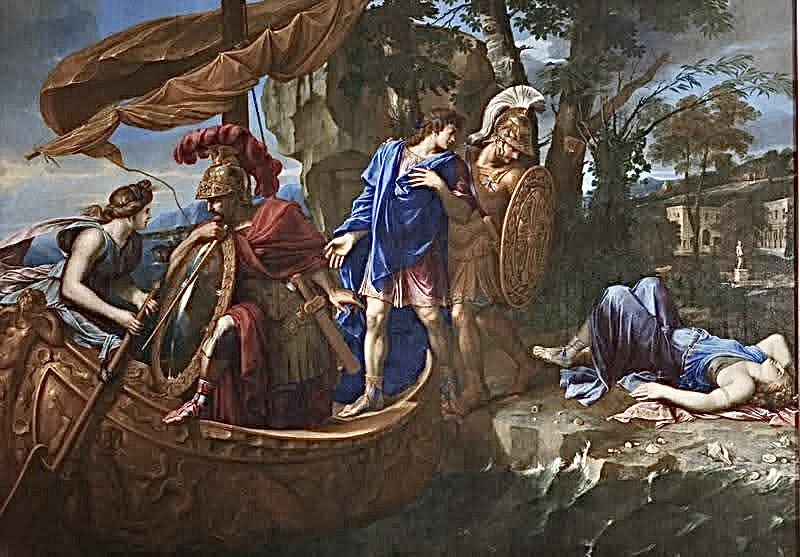
Painting, Renaud abandonnant Armide, Charles Errard (17th century)
These are some of the known composers of various operas Armida and/or Rinaldo:
Claudio Monteverdi (1627), Jean-Baptiste Lully (1686), John Dennis (1698), George Frideric Handel (1711), Antonio Vivaldi (1718), Tommaso Traetta (1761), Niccolo Jommelli (1770), Antonio Salieri (1771), Antonio Sacchini (1772, 1773), Christoph Willibald von Gluck, (1777), Josef Mysllivecek (1780), Joseph Haydn (1783), Giuseppe Sarti (1786), Francesco Bianchi (1802), Gioachino Rossini (1817), Antonin Dvorak (1908), and Judith Weir (2005).
There are three ballets–Armida, Le Paillion d’ Armide, and Rinaldo and Armida; and there is a 10-minute segment in the anthology film Aria that is loosely based on a version of Armide.
The operas named Armida or related to her character were black listed by the Roman Catholic Church in what was vernacularly referred to as the Black List. Officially known as the Index Librorem Prohibitorium, it listed banned books deemed heretical or contrary to Catholic morality since 1559. It was updated annually until Pope Paul VI abolished the end of its enforcement in 1966. Until then, many Armida works were banned!
Last but not least, the name Armida has several claims as to origin. “Little Armed One” is a more current meaning in Italian and in Spanish. However, according to the Wisdom Library, the name has an Old High German origin–Irmhild (Irm means something like “universal” and hild means “battle”). Moreover, the name is associated with the Arabic word “Armid to mean “strong-willed.” As “Ermin,” Armida symbolizes wholeness, completeness, and universality.
Notwithstanding the above paragraph, there is a shared etymology to the terms “army” (English), “armada” (Spanish/Portuguese), “armata” (Medieval Latin), and “armée” (French). They are derived from ar(e) or h2er, a Proto-Indo-European root that means “to fit together” as in arming or equipping for service or battle. Strangely enough, the Italian word for army is “esercito”. The Latin arma, to mean weapon, appears throughout the Romance family of languages. In Celtic languages, it cognates as arf or arm. In Ancient Greek, it is harmos (fitting together); in Sanskrit, it is irma; in Old Armenian, it is armukn.
Attestation of arma appears in Early Latin inscriptions of the 6th century BCE. In Ancient Greek, harmos appears in Homeric and classic texts. And, in Sanskrit, irma appears in Vedic and classical Sanskrit, relating to the meaning of “limb” and “fitted part” and somewhat like Sanskrit ayudha, which in Spanish translates as “help” or “aid”. All this leads to the conclusion, linguistically and culturally, that these terms evolved somewhat independently in accord with regional religious, military, and cultural priorities but retained a core concept of fitting, arming, aiding, and weaponry.
But, we still have no idea why Tasso used the name Armida; and yet, it is a befitting name for a she warrior.
Overall, the name embodies themes of strength, femininity, independence, empowerment, and allure, even power is softness, making it a captivating name in various cultures.
Armida is pronounced “ar-MEE-dah.
 Armida Nagy Rose Author