The Armida Trilogy link
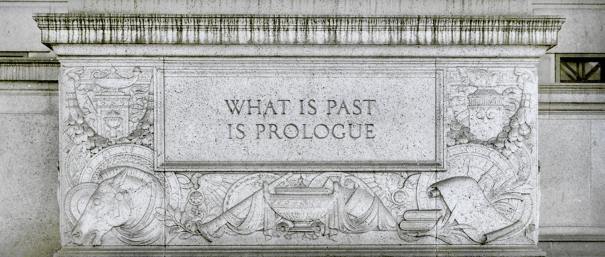
The contemporary use of William Shakespeare’s quote, “What’s past is prologue,” means that history sets the context for the present.
This indelible quote is engraved on the
National Archives in Washington, D.C.
When Shakespeare penned the above quote in The Tempest (Act 2, Scene 1 (1611)), Antonio rationalizes to Sebastian that “they are fated to act by all that has led up to that moment. In other words, the past set the stage for their next act, which was to commit murder; but they made their own destinies, not destiny itself, but by choice. Their choice was pure sophistry (“the use of clever but false arguments, especially with the intention of deceiving”).
From sophistry to modern chicanery (“the use of deception or subterfuge to achieve one’s purpose”), this article broaches both forms into one false and deceptive argument that was at best propaganda, promoting on Sunday, May 17, 2026, that the United States of America (U.S.) was primarily founded as a Christian nation. Many officials of The Trump Administration spoke at this large-scale religious gathering, titled, Rededicate 250: A National Jubilee of Prayer, Praise and Thanksgiving, held on the National Mall, a park near the downtown area of Washington, D.C. The speech video that was most disingenuous was presented by the U.S. Secretary of State, Marco Rubio who rationalized that the Mayflower Pilgrims made the U.S. a Christian Nation. Historians, acknowledging that such a concept is complex, disagree because founding documents prioritized religious freedom over a specific religion. Afterall, the Pilgrim Fathers, as did the Founding Fathers, wanted religious freedom, too, and fled England to have such freedom.
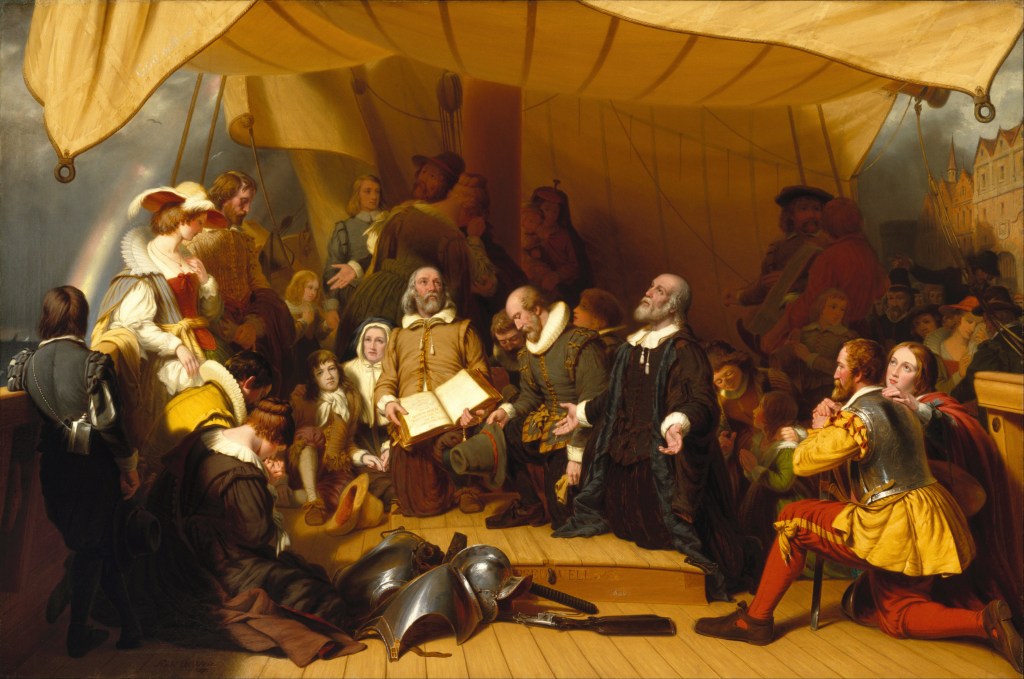
Just like the Sephardic Jews left the Spanish Netherlands to the Dutch Caribbean region (Daughteres of the Dance, pg. 24 ) the Pilgrims, a group of English Separatists of the 17th century, fled religious persecution in England, settled in the Netherlands (c. 1607), and financed their voyage to the New World (not to the U.S.) in 1630. England. They are the Mayflower Pilgrims (Pilgrims).
The Embarkation of the Pilgrims, by Robert Walter Weir (1857)
England was depicted by state control over religion characterized bya hierarchical and centralized Church of England that was enforced into widespread religious conformity by law. It was an intolerable environment for those who sought religious freedom. History has several distinct diasporas described by their religious identity–African (Yoruba, Vodou and Candomble); Christian (mainly from Africa, Asia, and Latin America regions); Global minority Muslim outside the Islamic world; Jewish; Tibetan Buddhist; and Zoroastrian (Parsi) Diasporas). Sadly, when belief systems act as mental frameworks of “absolute truth,” by their very nature are often divisive due to several psychological and social mechanisms (e.g., in-group favoritism, moral conviction, and cognitive bias) thus inherently creating division between varying ideologies).
Based on major demographic data, it is estimated that there are 14 major Christianity categories amounting to about 62-68 percent of the total Christian participants. The single largest individual denomination is Catholic at about 21-23 percent.
The growing rise of Americans who claim no religious affiliation (“nones”) is about 22-30 percent. Non-Christian faiths are about 6=7 percent (Buddhist, Hindu, Jewish, Muslim), Other religions (Unitarian Universalist, Native American religions, Wiccan) are at about 1-2 percent of religious affiliations.
It is opined that the religion that was promoted in Washington, D.C., is basically for the privileged White Christian majorities, which have dropped by 41 percent while Hispanic Catholics and Protestants are on the rise. It was designed to call them to come forward “with true penitence of heart and with the most revenant devotion. [to] publicly .. acknowledge the over-ruling providence of God” as espoused by the U.S. Secretary of State Marco Rubio. The rhetoric was beautifully crafted, but it was politically and religiously charged with misleading concepts that the U.S. was founded as a Christian nation. (See video below that discusses in depth the Rubio speech.)
Secretary Rubio’s speech injects the following: “From the beginning, we have carried the belief that our country represents something new in the world. But the soul of our Nation has always been rooted in an ancient faith.” The first part of the statement, psychologically speaking, is consciously true; the second part of the statement injects deception, always followed by a “but.”
It is true that the historical Mayflower Pilgrims influenced the Founding Fathers of the U.S. Constitution by providing the precedent for self-government, consensual lawmaking, and religious dissent. However, after 169 years of American history between the Pilgrims and the making of the U.S. Constitution and other supporting documents, the Founding Fathers were influenced more by the zeitgeist of the age (the defining spirit or mood of a particular period of history as shown by the beliefs, cultural trends, ideas, and values of the time). In other words, the defining spirit of the time was the Enlightenment Age, marked in part by an emphasis on reason, empirical evidence, individual rights that fundamentally reshaped society, politics, and philosophy.
For example, they believed that human beings could use rational thought to solve problems and improve their lives, moving away from superstition and dogma. This included ideas about personal liberty, religious tolerance, and the belief that Americans should have the right to think and act freely without coercion. It was marked by skepticism toward established institutions such as the Christian church and kingdom (aka monarchy) in which persecution of individuals with different belief was an action plan. They definitely adhered to freedom of worship, which is apparent in the “Establishment Clause” of the First Amendment to the U.S. Constitution which prohibits the Federal government from establishing a religion or from unduly favoring one religion over another. (See illustrative slide below.)
The “Establishment Clause” reads as follows:
Congress shall make no law respecting an establishment of religion, or prohibiting the free exercise thereof.
In plain English, it is interpreted to mean that there should be a clear separation between government and religious institutions, insuring that the government is not to favor and is not to endorse any religion. In a letter to the Danbury Baptist Association in 1802, Thomas Jefferson wrote that the First Amendment created a “wall of separation” between church and state, ensuring the religious belief and practices would not be influenced or controlled by the government. Thus, the metaphor “separation of church and state” became a foundational concept in American constitutional law on religious freedom.
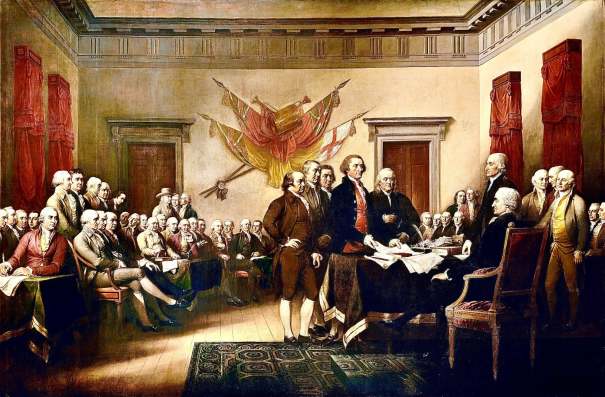
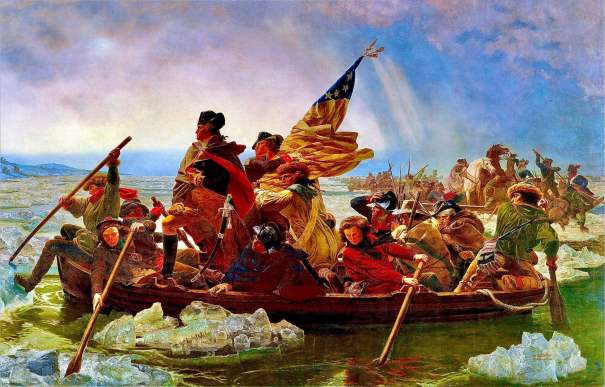
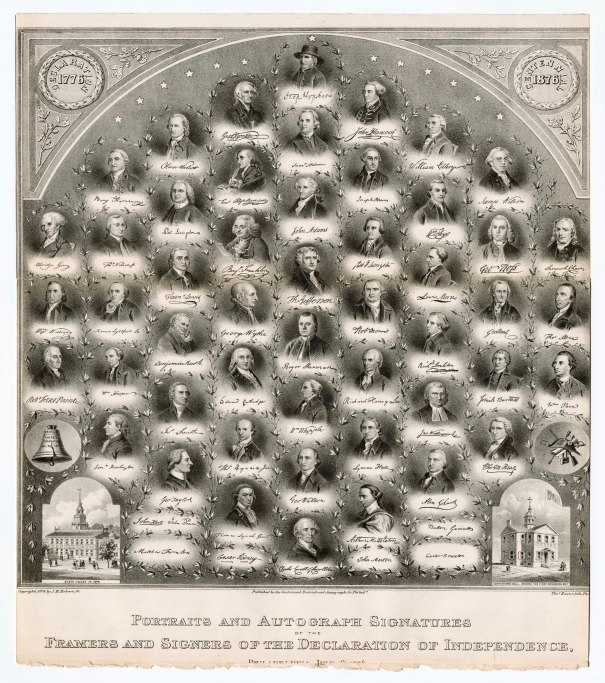
It should be noted that the Founders were not a monolith but a spectrum of orthodox Christians, Rationalists, and Radical Deists. However, on Sunday, May 17, 2026, a “Christian Revival” was held on the U.S. National Mall as a faux revival, Rededicate 250: National Jubilee.... It was really a rally organized by a Trump-aligned group, Freedom 250,* and backed by the Trump Administration with the objective of “rededicating” the U.S. as “One Nation Under God”. Among those who recognized this day-long prayer rally as a Christian nationalist movement, many have expressed concern that it promoted an exclusionary vision of American identity rooted in whiteness (white systemic privileges) and Christianity, despite the inclusion of a token rabbi and two Catholic speakers. Among the speakers who appeared on pre-recorded videos were President Trump from the Oval Office and other senior officials of the Trump Administration and the Speaker of the U.S. House Representatives, a religious fanatic of the Christian right faction of the Republican Party. The Speaker of the House, third in line in presidential succession, has stated, explicitly albeit erroneously, “the founds wanted to protect the church from an encroaching state, not he other way around.” As an evangelical and Southern Baptist, he has said, “My faith informs everything I do.” There is no room for rational thinking, for he knows absolute truth.
To folks like Speaker Johnson and the Pilgrims, a contract made before God was absolute and unbreakable; and they used their fear of breaking a vow to God as the “glue” that held their new community together. Yes, the Pilgrims did dissent against a European king ruling by “Divine Right” (God placed the king (as proxy for Jesus of Nazareth) in charge, and everyone else as subject). In other words, a theocracy that controlled the “free will” of its subjects. The biggest contribution of the Pilgrims was to turn this hierarchy upside down, for they believed that all men were equal before God. Thus, following the argument is that no single person has a natural, divine right to rule over anyone else. Consequently, under the aegis of the Enlightenment Era, even the Pilgrim’s spiritual equality led to political equality. Thus, by 1776-1787, the language of the Founders shifted from deep religious to a detached approach to religion with a secular and rational eye of the Enlightenment Age. In essence, from “puritanical zeal” to “deism and rationalism.”
Despite the speeches made by President Trump, Secretaries Hegseth and Rubio, and Speaker of the House, the Pilgrims came to the New World to build a community were their specific religion was the law of the land–if you did not agree with their theology, you were not allowed to vote and could be banished from the colony. Ironically, the Pilgrims, who inspired a structure of self-government, did not protect their colonies from religious radicalism. The Founding Fathers did protect the country from religious radicalism. The Puritans wanted their own theocracy. And this is where the danger lies with the current White Christian Nationalism in the United States.

The “Pine Tree” flag: : When flown outside a historical reenactment or maritime context, it projects a specific blend of conservative political alignment, American patriotism, and conservative Christian faith (2013-present0
At the Rededicate 250: National Jubilee.... of May 17, 2026, the “Appeal to Heaven” flag (aka “Pine Tree” flag) was flown, which is a recontextualized historic American Revolutionary War banner to symbolize the Christian Nationalist movement with right-wing political activism in the U.S. The historical phrase “An Appeal to Heaven” is a justification to rebel against a ruler when there is no legal remedy left on Earth. Its current meaning by the Christian Nationalist is, basically, for a spiritual campaign to “restore American to the Christian nation God intended” with a mandate to control seven key facets of society–government, education, media, family, business, science/technology, and art/entertainment), a revolutionary overhaul.
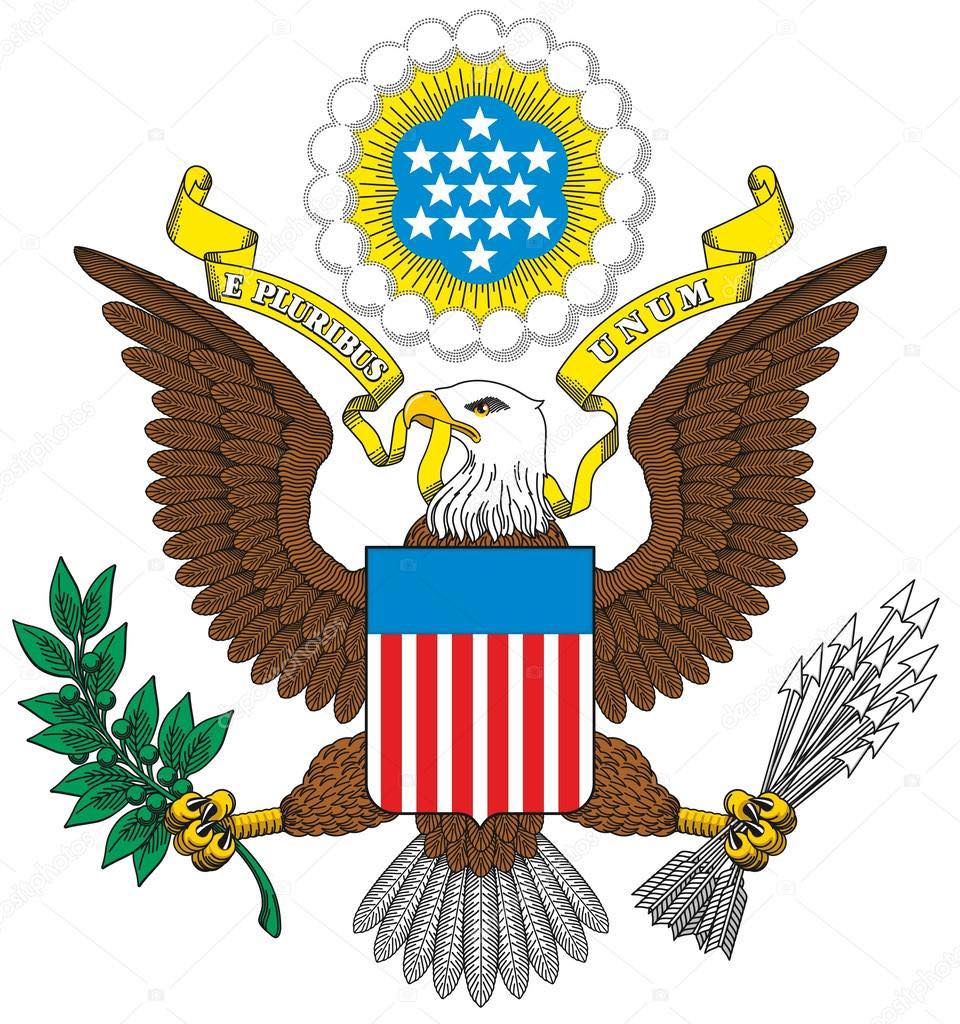
United States Coat of Arms that embody the Nation’s core ideals of freedom, democracy, and resilience.
E PLURIBUS UNUM (Latin phrase that translates to “OUT OF MANY ONE.” It is a traditional and historically significant motto of the U.S. that symbolizes the country’s creation as a unified nation formed by the merging of many disparate entities (pluralistic nature, a melting pot of people from many different backgrounds, cultures, and beliefs to form one single country).
Threatening the U.S. Constitution, the Republic, and democracy, white Christian nationalism is a significant shift in modern American politics. Since white evangelical Christians and conservative Catholics make up the most single, reliable voting block for the Republican Party, a strategic plan has employed electoral strategy and mutual benefits to deliver on transactional promises, such as anti-abortion and comparing their new religious leader–Trump as King Cyrus or King David–as God’s will to use flawed vessels to protect his people. And then to claim a shared rhetoric of “cultural grievances and persecution” by using combat language to crusade against “atheists, globalists, Marxists, and the like”. Also, as an afront to the U.S. Constitution, the White House has institutionalized within the Federal government high-profile personnel who openly endorse Christian nationalism and has established the White House Faith Office to favor specific conservative theological networks. And it further has made an “America First” foreign and domestic policy platform.
The phrase, “Now is the time for all good men to come to the aid of their country,” is truer than ever when the spiritual and political rights of individuals are threatened. To preserve a constitutional democracy in the face of aggressive nationalism is a complex challenge for any society to face. According to the American Presidency Project, only 57.8 percent of actual voters voted in the 2024 Presidential Elections; 63.1 percent of eligible votes did NOT vote! When apathy votes in silence, there are no guardrails that will not withstand an onslaught of stronger views antithetical to Constitutional safeguards. It requires a redefining of “national pride” needs to shift from exclusive identity to an inclusive one that is civic. To be an American, at its core under the U.S. Constitution, is defined by a shared legal status and a commitment to a set of civic ideals. The U.S. Constitution defines citizenship as “All persons born or naturalized in the United States, is subject to the jurisdiction thereof, are citizens of the United States and of the State wherein they reside.” As an American, one should want to protect the guarantees under the U.S. Constitution–freedom of expression, equal protection, due process, political participation, including civic responsibility by respecting the rule of law, jury duty, defending the Nation, and, last but not least, participating in governance. Be a part of this precious ongoing experiment. Otherwise, the fall of democracy will be followed by tyranny.
Please safeguard your freedoms as an American if you are a reader of this post. Why so many because there are not that many illegals and illegals that have committed other crimes, for so many have already been deported? Here is one reason why there are so many detention centers that exist and how many are planned (for naturalized Americans, for those deemed traitors and political enemies…):
The Trump administration currently operates over 100 detention facilities holding approximately 68,000 people as of April 2026, a significant increase from roughly 35,000 a year prior. To support mass deportation goals, the administration plans to expand capacity to 92,600 beds by September 2026 through a “Detention Reengineering Initiative” that includes acquiring eight large-scale detention centers and 16 processing sites.
The administration aims to create a “hub and spoke” system modeled after Amazon logistics, utilizing seven to eight renovated industrial warehouses as central hubs capable of holding 5,000 to 10,000 detainees each. Specific planned locations include a facility in Stafford, Virginia, a converted warehouse in Social Circle, Georgia, and a network of detention camps on military bases such as Fort Bliss, Texas, which is designed to hold up to 10,000 people. Additionally, the plan involves reopening former prisons and utilizing international sites like Guantánamo Bay and facilities in El Salvado.
This expansion is backed by a $45 billion allocation for immigrant detention within the DHS budget, the largest amount ever dedicated to this purpose. Acting ICE Director Todd Lyons has stated the goal is to treat deportations “like a business” to increase efficiency, with contracts already awarded to private prison operators like GEO Group and CoreCivic to manage dozens of facilities across at least eight states. | May 28, 2026
Footnote *
Freedom 250 is a highly organized system (i.e., a propaganda machinery), established by the White House to coordinate national events, have the following people behind it that spans a mix of federal executive leadership, specialized task forces, and institutional partners:
The White House Task Force 250; Secretary of Energy Chris Wright; Secretary of Health and Human Services (HHS) Robert F. Kennedy, Jr.; Hillsdale College where alternate “Story of America” video series and digital curricula used in the mobile exhibits; Civics Education Coalition of educators and civic leaders who organize a 50-state campus lecture series and manage the History Rocks! Freedom 250 Trail to Independence Tour (their “Freedom Trucks,” art mobile museums that travel across the 48 contiguous States to bring interactive “history exhibits” to local schools, sporting events, and libraries directly).