
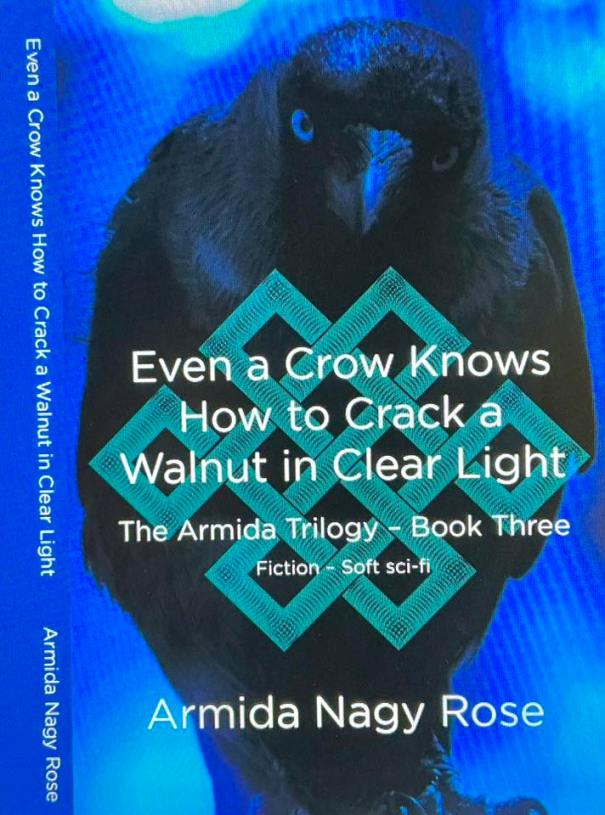
BOOK THREE – Even a Crow Knows How to Crack a Walnut in Clear Light. March 2026)
It may be safe to say that the novel Even a Crow Knows How to Crack a Walnut in Clear Light is undergirded by subtle Eastern philosophical views. For this reason, the the “endless knot” appears on the front and back cover of the book.
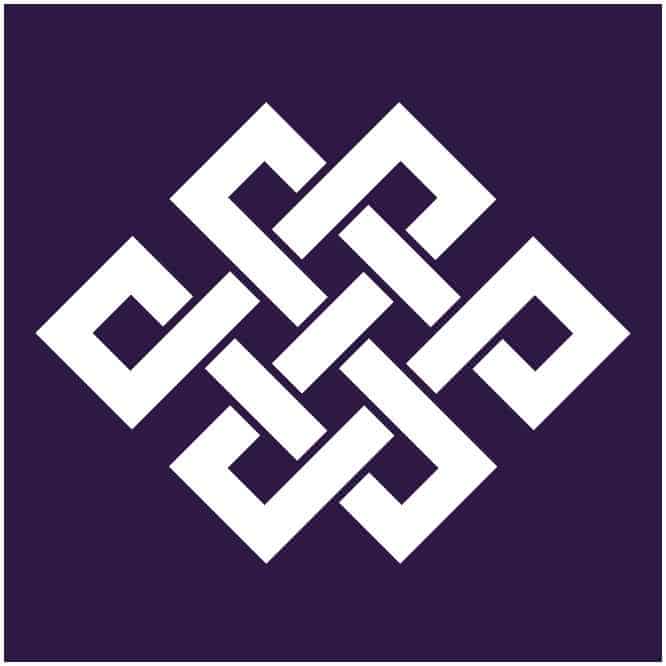
Known also as the “eternal knot,” it is a symbol that features a closed, looped design with no beginning or end. You may have seen it in Chinese art and knots, but it is a cultural market where Tibetan Buddhism is influential. We can even think it is somewhat like a torus in which the surface revolves as a continuous circle in three-dimensional space that creates a system that maximize grid capacity by storing excess electricity and by deploying the electrical charge when needed, thus aligning power generation as demanded.
On the other hand, the “endless or eternal knot” speaks of such energy in spiritual terms such as infinite wisdom and compassion, the interconnectedness of all phenomena, and the continuity of life, death and rebirth. Before indulging in the symbolic meanings, usage, and context of this symbol, please view the following link to know how this novel connects western and eastern philosophies, and modern physics. There are several philosophical/physics thoughts are injected in Even the Crow Knows….
https://www.facebook.com/share/r/1CPrKQi61G
The following is an AI overview of this symbol:
Interdependence: Also known as dependent origination, it shows that all phenomena are interconnected and rely on causes and conditions.
Union of Wisdom and Compassion: The intertwined, inseparable nature of wisdom and method as compassion, are essential for enlightenment.
Endless Cycle: The union of opposites (e.g., calm and movement, Tao, yin-yang) and the dominant cycle of rebirth.
Buddha Shakyamuni’s Teachings: Remarkable teaching that manifest as boundless, omnipresent wisdom.
Usage and Context: Serves as a common cultural marker, art, amulets, and in sacred geometry to sere as a meditative focus on non-duality and unity.
Lastly, the knot, although slightly different in designs, is found in Hindu, Jain, and Celtic traditions, often signifying eternity or longevity. In ancient India, it was a symbol of auspiciousness and harmony.
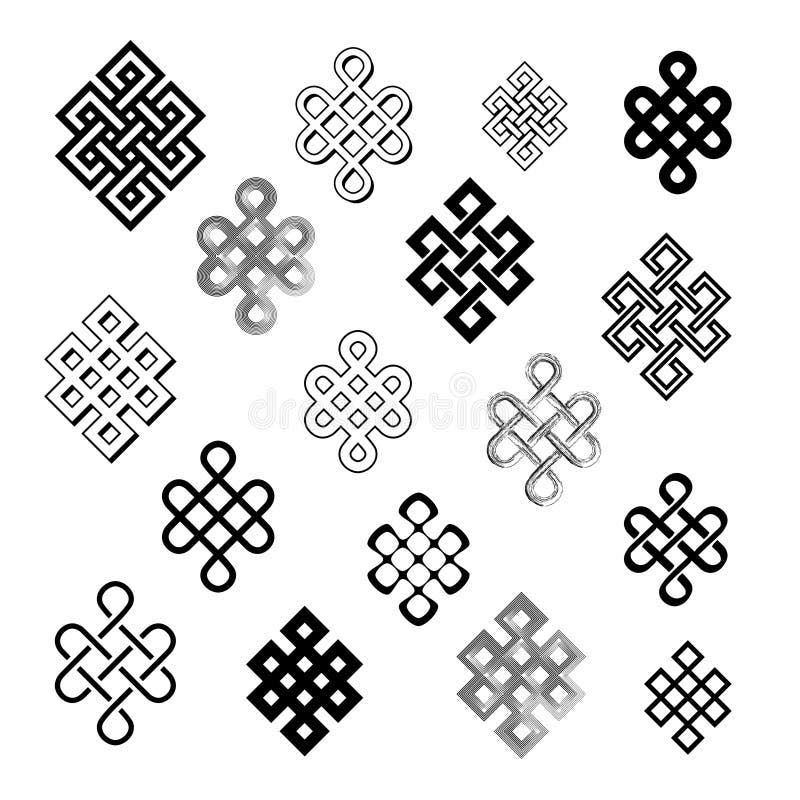
As stated by Bulgarea Candin Stefan, “Interestingly, the religious symbol of the Eternity Knot is said to represent the interdependence between secular and religious matters. Originally, this symbol was associated with Vishnu and his abiding love for his consort Lakshmi, goddess of prosperity and wealth. You can find the endless knot symbol on various inspirational products such as infinite knot decor, infinite knot pendant, and more.
“Knots are certainly deeply rooted in our consciousness as archetypes.”
The author, however, implies that it represents the physics of the Tao’s yin-yang of Quantum Theory.
 Armida Nagy Rose Author