
Throughout civilizations there have been symbols that dominated archeological findings. For example, the eagle, the serpent, and the variant crosses as the dominant ones throughout the rise and fall of civilizations. As modern Homo sapiens sapiens, we are familiar with these with a slight understanding of their meaning or symbolism.
The historical novel, the subtitle of CHOIR OF CLOISTERED CANARIES is “Symbols for Everything under the Sun and Moon.” Each chapter has a designated symbol as a sub-theme for the chapter; and there is an appendix at the end of the story, explaining the use of the symbol.
Nonetheless, as impossible as it is to portray all the symbols that exist under the sun and moon, there are some very ancient symbols, which may not have been dealt with in the novel, are briefly explained below—the eagle, the serpent, the cross, the pine cone, the “handbag,” and others.
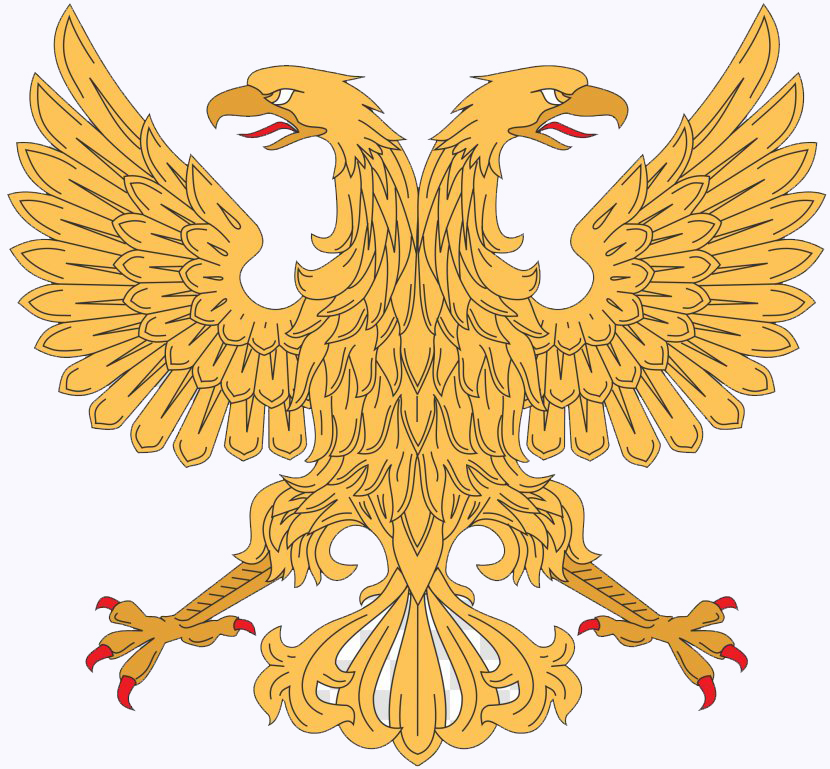
It is still debated as to which civilization is the oldest—the Indus Valley or Sumer or Egypt. However, as time passed, symbols were used as an abbreviation of what was involved in explaining the consciousness of the acts or intentions. By way of example, the Eagle head represents kingship, war, and conquer.



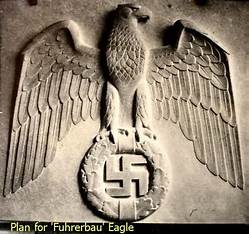


Note that slides six and seven seem similar. Slide six is early Byzantian; slide seven is a rendition of the Russian eagle.
An ancient example of the mighty bird symbol is found in the encyclopedic, Puranic literature that predates many traditions of Proto-Indus-Europe and Avesta literature. That legendary two-headed eagle of unimaginable strength is known as Gandaberunda. According to Wikepedia, the wrath of Narasimha (incarnated in the form of a part-lion, part-man) needed to be quelled, otherwise, he might furiously destroy the cosmos. The devas (gods) approached Shiva for help. To protect the cosmos, Shiva manifested as the fiercely being Virabhadra. When Narasimha refused to simmer down, Shiva took the form of Sharabha, a part-lion and part-bird beast who then fought Narasimha. It was then that, in his resistance, he took the form of the two-headed Gandabrunda who was even stronger than Narsimha. The two forces fought fiercely for 18 days. Defeating Sharabha to restore Narasimha’s sense of calm, he discovered how ruthless and wasteful his wrathful behavior, destroying everything in their wake. Their battle caused a great devastation and recognized it was better to be peaceful instead of destructive. Sharabha removed the skin of his body and presented it to Gandaberunda. Upon its self-awareness, the Gandabrunda split in two, giving rise to Shiva.
In our current mythology, the eagle represents rule, governance, and nations to control the subjects/citizens. The legend was supposed to teach that war is not necessary and that it is better to maintain peace by achieving balance. In some quarters, the balance between shiva and shakti (male and female) has to be achieved; otherwise, the cycle of rise and fall of civilizations will remain in perpetuity.

As symbols, the eagle, serpent, handbag, and pine cone represented the keepers of knowledge to jumpstart change to create civilizations. Until recently, their meanings were hidden. Sometimes, generally speaking, many symbols stood the test of time or where inverted or even perverted as evil.
The pine cone (pigna in Italian) is prominent at the Vatican that leads to the main entrance of its library and to the entrance to the Secret Archives of the Vatican. Known as the Fontana della Pigna, this large, bronze pine cone is dated around the first century of the Common Era and believed to have been relocated from Hadrian’s tomb. It was once located between the Pantheon and the Temple of Isis in Rome. Even the Pope’s staff has a pine cone carved at the base of the wooden portion of the staff.


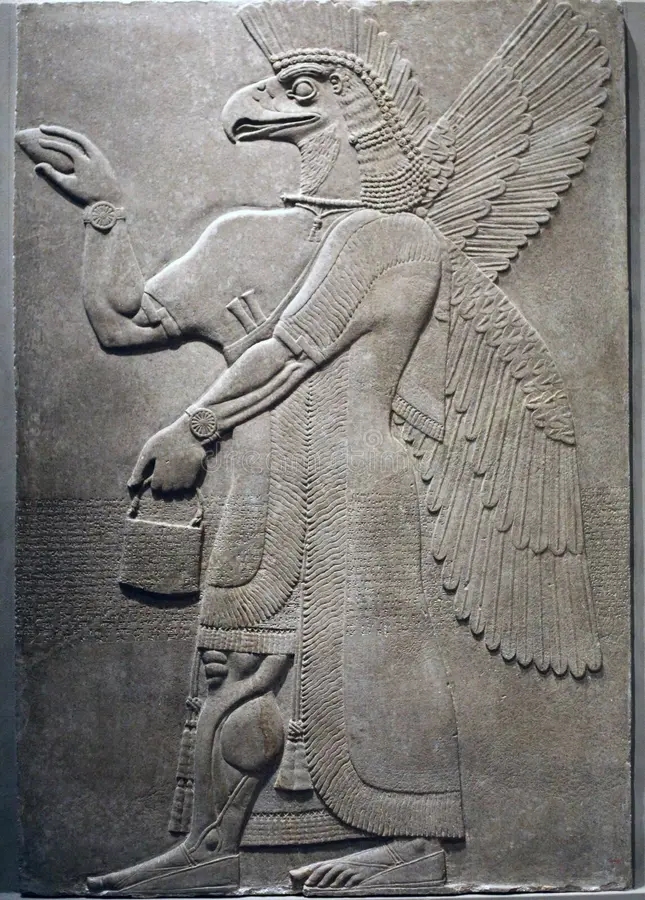
Other notable places to find the pine cone . . . The staff of Osiris intertwined with two serpents. Hindu gods have pine cones in their hands. Shiva’s hair is woven with snakes in the shape of a pine cone. Using the pine cones with serpents represents spiritual consciousness…the third eye, enlightenment, immortality. It should not be surprising to understand why the Roman pine cone was moved in front of the entrances to knowledge and hidden wisdoms. There are Assyrian carvings of god-like figures as men/eagle heads holding pine cones aloft in their right hand. The Assyrians also show a pine cone being used to fertilize the Tree of Life. A statue of a Mexican deity, Chicomecoatl holds a pine cone and evergreen tree branches. Dionysus also carried a staff topped with a pine cone.
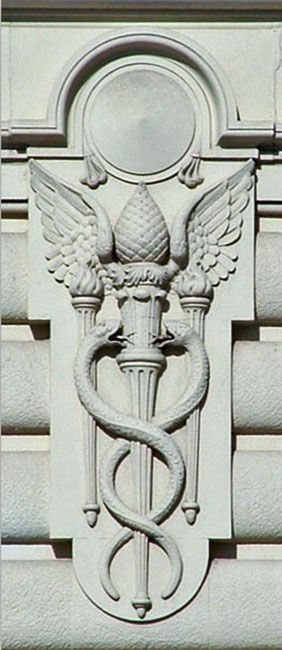

The current understanding of the pine cone represents knowledge and the passing of wisdom, the cosmic consciousness of existence itself. That understanding, moreover, is applied to other symbols.
Pine cones contain the fibonacci sequence and have been a symbol of enlightenment throughout history. In mathematics, the Fibonacci sequence is a sequence in which each number is the sum of the two preceding ones, implying balance.
The pine cone and the “handbag,” which I opine is best described as a “tool bag,” is often represented together and is often depicted being held in the left hand.
The symbol of the “handbag” is probably the most debated. Perhaps the best current understanding is that it represents the tools necessary to build, materially, a civilization. It existed prominently in early Assyrian and Mexican civilizations with its pyramid and other megalithic structures.
The “handbag” is even found at Gobekli Tepe, Pillar 43! Gobekli Tepe is an active archeological site in the Southeastern Anatolia Region of Turkey, which is almost 12,000 years old, predating Sumer. Likely commenced by hunter-gatherers who were organized and already stylized in their expressions at the end of the Ice Age, it is a marvel and mystery.
As a transitional piece, I introduce a later rendition of the pine cone and the “handbag” being held by an earlier deity, Oannes, as a fish body with head and feet of a man.
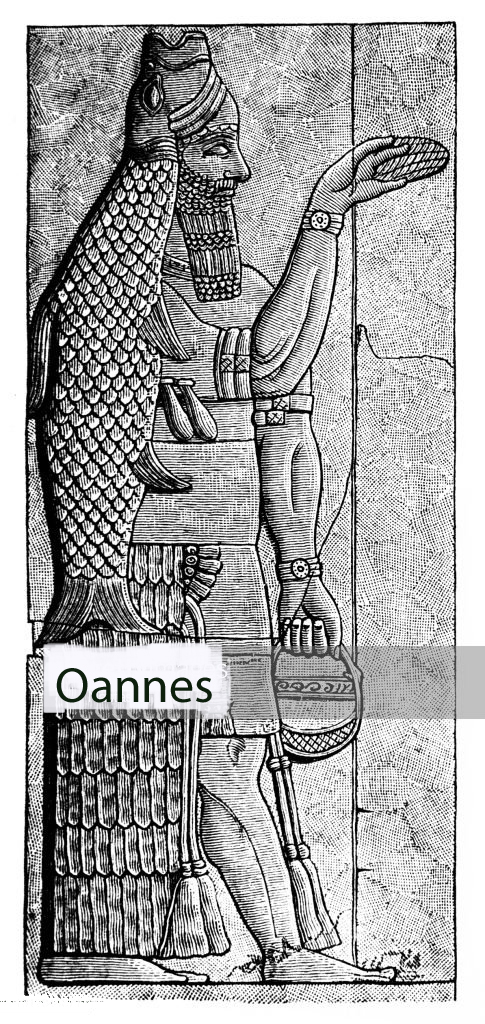
In Mesopotamian mythology, Oannes taught mankind civilization. In various depictions, he was clothed with a fish costume, representing an amphibious being. A Babylonian tablet was unearthed in the ancient Sumer capital of Uruk (current Warka, Iraq). Known also as Adapa and Uanna, Oannes was a 4th-century-BCE deity who taught the inhabitants of the Persian Gulf the written language, the arts, arithmetic, medicine, astronomy, politics, ethics, and law. The knowledge he imparted in astronomy, for example, was so precise for that time that the rotation of the moon was off by 0.4 from contemporary computer calculations. Note, too, that his eyes are closed as if transcendental.
Keep in mind that Sumer as a civilization emerged during the Chalcolithic and early Bronze Age (sixth-fifth millennium BCE).
There are other depictions of the “handbag” carriers as noted above.

As for the serpent and the cross, these symbols have been around both of which have had their meanings inverted and/or perverted over time.

In more recent times, originating as a design element, the Star of Life is used internationally to identify emergency medical services and found on ambulances, medical personnel uniforms, medical bracelets, and the like, using the Rod of Asclepius, the ancient symbol of medicine. In some countries, its use is restricted to authorized personnel.
Carl Jung, a Swiss who founded analytical psychology, influenced the fields of psychiatry, anthropology, archaeology, philosophy, religious studies, and the like, once said that “the serpent shows the way to hidden things.” As such, variant symbols of the serpent have been used to represent spirit, the divine, enlightenment, and the power of transformation. In essence, to understand the hidden nature of things, an understanding of wisdom is required.

According to the Bhagavata Purana, Purusha Sukta, Narayana Sukta, and the Narayana Upanishad from the Vedas, the Seven-headed Narayana represents the ultimate soul or supreme consciousness. According to Madhvacharya, Indian philosopher of the school of Vendanta, Narayana is one of the five manifestations of Vishnu, albeit masculine in energy, which are cosmic emanations in contrast to his incarnate avatars.
As for those versed in the Hebrew scripture, the serpent tempted Eve to eat from the fruit of the Tree of of Knowing Good and Evil. Pardon me, but it seems that the message to the inhabitants who were told this version, were told to not listen to reason but to their leaders be they rulers or priests. Just saying. When Eve ate of the fruit of that tree, what is the impression of the fruit did she have? “When the woman saw that the fruit of the tree was good for food and pleasing to the eye, and also desirable for gaining wisdom.”


From the ancient Egyptian Book of the Dead, the serpent regains its legs.
Then there is the crucified alchemical serpent. The serpent is crucified to “fix the volatile” or that which is changeable.
There are many other great serpent imagery such as the Kundalini. In Sanskrit, kundalini means “coiled snake” and represents the divine feminine energy force that resides at the base of the spine. Sometimes it is represented as two intertwined serpents. The process of it rising towards the top of the skull signifies awakening of the mind that includes both female and male energies that, apparently, stimulates the pineal gland (aka third eye) to experience unseen truths. Is this what Carl Jung meant?
As for the cross, we know it is a prominent symbol in Christianity; but it predates the Christ crucefics by millennia.
One of the famous carved megalithic pillars at Kobekli Tepe (Pillar 43), illustrates under three “handbags” a vulture holding an orb and a scorpion below. Upon astrological analysis, the vulture and scorpion represent the constellations Cygnus and Scorpius, aligned with each other. Furthermore, the orb, representing Deneb (one of the brightest stars in our galaxy) is connected to Cygnus and together, they form a cross. This ancient rendition of the cross symbolizes the crossing of energies–mind, body, and consciousness–to attain awakened awareness or ascension.

This is certainly food for thought, and the questions are endless when how great past civilizations ended.

Last but not not least, modern science call the pineal gland an atrophied third eye that needs to be exercised–Kundalini yoga is a good start. In Buddhism, it is referred to as the third eye: the vajra thunderbolt where the dimension of other realms is charged with immense lights of kundalini rising. When the preacher of Ecclesiastes 1:9 said there is nothing new under the sun,” what was the height, depth and breadth of his or her knowing?
Choir of Cloistered Canarlies explores some of these themes, especially the symbols for immortaility.
 Armida Nagy Rose Author